Couples frequently allocate budget for reception entertainment assuming a photo setup is a single, standardised piece of hardware, only to find their final wedding photobooth cost fluctuates wildly based on the underlying technology and staffing. The assumption that every camera-and-backdrop combination does exactly the same job leads to either overspending on unnecessary tech or under-equipping a large venue. Relying on basic averages without examining the underlying hardware is a fast route to logistical failure on the night.
Quick Summary
The cost of a wedding photobooth is determined by the hardware format, print logistics, and the staff required to operate the unit. Prices scale with mechanical complexity, ranging from standalone digital pods to large mechanical video spinners.
– Digital selfie pods offer the lowest overhead by removing print media and attendants.
– Print booths incur higher costs due to physical consumables and the necessity of on-site staff.
– Video spinners demand strict safety exclusions and high-speed processing, driving premium rates.
– Transport and idle hours heavily dictate the final invoice for remote or all-day setups.
Table of Contents
- Evaluating Your Wedding Photobooth Cost
- 1. Standalone Digital Selfie Pods
- 2. Classic Enclosed Print Booths
- 3. Magic Mirror Interactive Displays
- 4. 360-Degree Video Spinners
- 5. Vintage and Converted Vehicle Booths
- 6. Operational Duration and Idle Time
- 7. Attendants and Turnaround Logistics
- Hardware Summary Table
- Matching Your Reception to the Right Setup
- FAQ
- Recommended Reads
Evaluating Your Wedding Photobooth Cost
Comparing entertainment hardware is rarely straightforward. To determine whether a quote represents value, every option below is judged on two specific criteria: mechanical complexity and operational friction. Mechanical complexity measures how many moving parts, consumables, and software licenses are required to capture an image. Operational friction measures what the unit demands of your venue – how much floor space it takes up, whether it requires dedicated 16-amp power, and if an attendant must stand beside it all night. These two factors dictate the baseline rate before any geographical travel is added. If you are comparing 7 Professional Photo Booth Rental Services for Your 2026 Event, use these criteria to separate the premium hardware from basic webcam setups.
1. Standalone Digital Selfie Pods
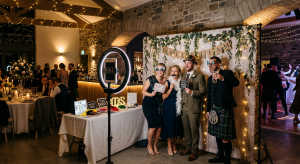
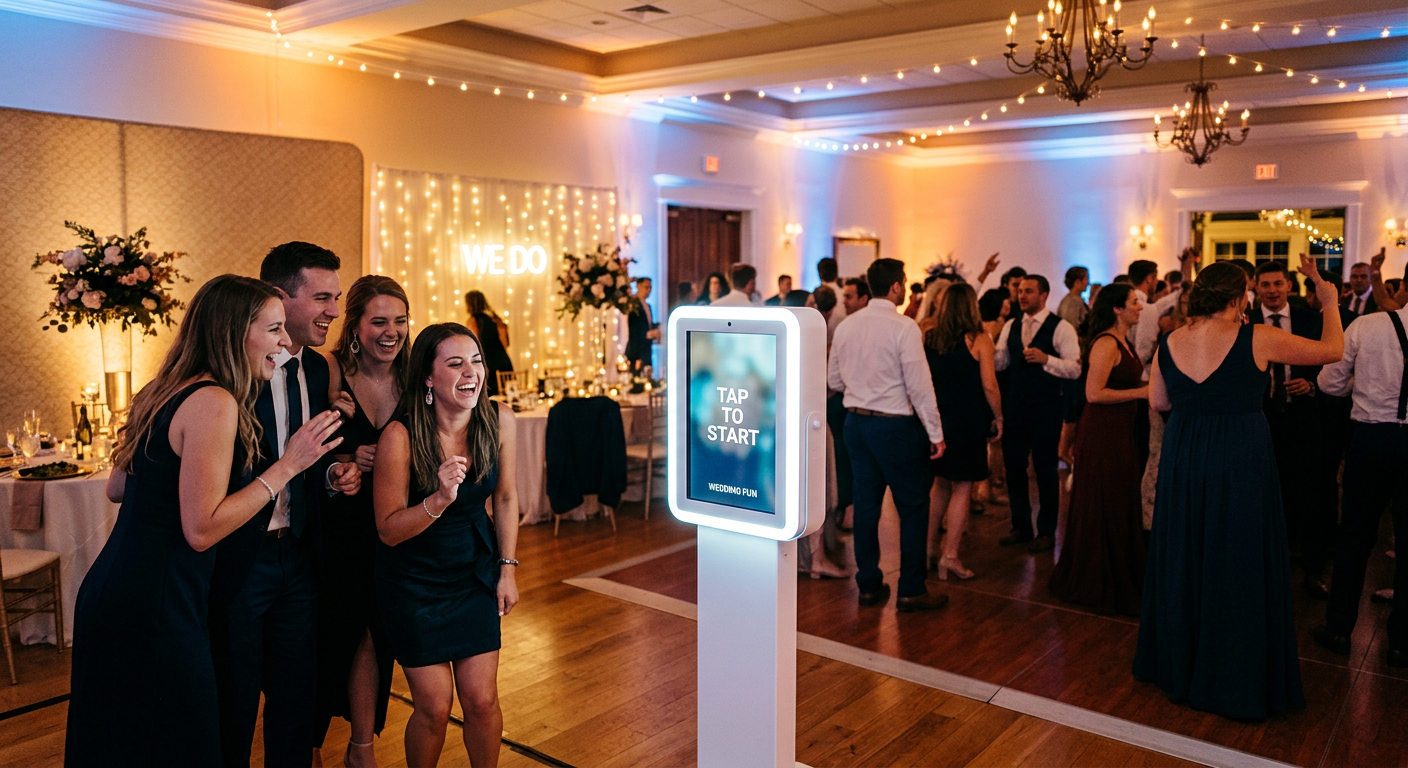
These are highly compact, touchscreen-operated towers or ring-light stands designed solely for digital image capture. Because they lack physical dye-sublimation printers, they represent the most cost-effective tier, typically starting from £200 for a standalone hire or as low as £125 when bundled as an add-on to existing entertainment packages.
The mechanism relies entirely on an integrated iPad or commercial DSLR linked to cellular software. Guests tap the screen, capture a still image, boomerang, or GIF, and instantly receive the file via SMS, email, or a scannable QR code. There is no waiting for paper strips to dry or print queues to clear. When you are looking at Choosing the Best Photobooth Website and Platform Features for Your 2026 Event, assessing how these digital units handle offline queuing if the venue loses internet is a critical step.
Instant social gratification replaces physical keepsakes
Omitting a printer is the primary advantage, but it also restricts the overall experience. This format completely fails older guests. They expect to walk away with a physical memento to put on their fridge. Without a dedicated attendant, a digital pod demands touchscreen confidence. Guests must navigate the interface entirely by themselves. If your reception is heavily populated by less tech-savvy relatives, a self-service digital pod will sit unused for large portions of the night. This happens regardless of how neatly it fits into the corner of the room.
2. Classic Enclosed Print Booths
This is the traditional hard-sided box or curtained pipe-and-drape system where two to four guests step inside behind a curtain. It remains the standard benchmark for wedding entertainment, built specifically to deliver physical prints on the spot.
The internal mechanism pairs a fixed camera with a commercial dye-sublimation printer hidden within the casing. When the sequence ends, the printer uses heat to transfer dye onto paper, producing dry, smudge-proof photograph strips in under fifteen seconds. This mechanical process demands regular paper roll replacements and ink ribbon swaps, which is exactly why these units strictly require a trained operator on site.
Nostalgic privacy restricts group participation
An enclosed booth deliberately limits who can take part at any one time. Squeezing an entire bridal party or a large group of university friends into a standard enclosed frame is physically impossible, often resulting in cramped, awkward framing where half the group is cut out. Furthermore, the massive footprint requires significant dedicated floor space. Venues with narrow corridors or low ceilings simply cannot accommodate the hard outer shell, meaning you risk paying for hardware that never makes it past the loading bay if you fail to measure the access route.
3. Magic Mirror Interactive Displays
Magic mirrors mimic the appearance of large, ornate full-length dressing mirrors but function as highly interactive touchscreens. They appeal directly to couples wanting a visually striking piece of hardware that blends into a glamorous or formal reception room without looking like a temporary pop-up tent.
Behind the two-way tempered glass sits a commercial display panel and a hidden lens. Custom software plays animations on the glass, inviting guests to walk up, strike a pose, and physically sign their creations on the surface using touch sensors before the image prints out from a detached base station.
Practical rule: Never place a highly reflective screen directly opposite a setting sun or a bank of intense venue uplighting, as the glare will render both the touchscreen animations and the final photographs completely unusable.
Visual impact demands careful placement
The heavy, fragile nature of tempered glass dictates severe logistical limits. Mirrors are incredibly difficult to transport up staircases, and most suppliers will flatly refuse to deploy them in upper-floor function rooms lacking a commercial lift. They also struggle in bright, naturally lit marquees where ambient reflections ruin the image capture. If your venue is outdoors or accessible only via narrow, winding stairs, skip the mirror entirely – the risk of transit damage and the restrictive setup requirements will outweigh the aesthetic appeal.
4. 360-Degree Video Spinners
Rather than capturing still photographs, a spinner records dynamic, slow-motion video. It is designed for high-energy receptions where the focus is on capturing the movement of dresses, confetti throws, and group dancing.
Guests stand on a raised, stationary metal platform while a motorised arm holding a high-frame-rate camera rapidly circles them. The accompanying software instantly processes the footage, adding speed ramps, reverse effects, and an audio overlay, before generating a compressed video file ready for instant download to a smartphone.
High engagement brings strict spatial and safety demands
The physical rotation of the arm makes this the most demanding piece of entertainment hardware you can hire. It requires a massive, roped-off exclusion zone – typically at least three by three metres – to ensure the spinning metal does not strike bystanders or venue staff. It cannot be squeezed into the corner of a busy dancefloor. If your venue lacks a dedicated, spacious alcove away from the main bar traffic, hiring a spinner is a logistical error that will create a severe bottleneck and an unacceptable safety hazard all night.
5. Vintage and Converted Vehicle Booths
This category encompasses classic campervans, restored horseboxes, and vintage cabs retrofitted with internal photography equipment. They are heavily favoured for festival-style weddings, barn venues, and outdoor summer receptions where the vehicle adds to the broader aesthetic.
The vehicle acts as a self-contained studio. Powered either by an onboard generator or a direct 16-amp external feed from the main building, the interior houses a standard camera and print setup, while the exterior provides a substantial visual prop for the venue grounds.
Aesthetic dominance requires outdoor logistical planning
Vehicle setups are entirely useless if your reception lacks flat, load-bearing access to the main entertainment area. Moreover, they force guests to leave the main party to participate. In adverse weather – typical of exposed regions like Aberdeenshire or the wider Scottish Highlands – guests simply will not walk across a wet lawn in formal wear to take a photograph. If your wedding takes place during a season with unpredictable weather, paying a premium for a converted vehicle means paying for an attraction your guests will actively avoid.
6. Operational Duration and Idle Time
Hardware is only one side of the invoice; time dictates the rest. Standard hires usually cover three to four hours of active operation, which comfortably spans the evening reception immediately following the first dance.
Suppliers often set up equipment at midday. This avoids carrying heavy transit cases through your drinks reception. However, the booth might only open at eight in the evening. This delay means you incur ‘idle hours’. This fee compensates the attendant for waiting on-site while the equipment sits inactive. For a detailed breakdown of how time scales with staffing, review Understanding Wedding DJ Cost and Budgeting for Your Celebration in 2026. This guide offers a parallel look at how early setups impact evening entertainment invoices.
Early assembly protects the atmosphere but inflates the bill
Booking a staffed booth for the entire duration of a wedding is a widespread financial mistake. The novelty of the hardware peaks in the first two hours and drops off sharply as the main dancefloor gets busy. Paying for active operation during the wedding breakfast or the speeches guarantees the machine will sit empty while you are billed for premium active time. Pay for the idle hours to secure a discreet setup, but strictly restrict the active run time to the evening party.
7. Attendants and Turnaround Logistics
The geographical location of your venue and the necessity of a human operator heavily shape the final quote. A remote highland castle naturally attracts higher transport and fuel surcharges than a straightforward city-centre hotel.
Whenever physical printing is involved, an attendant is mandatory. They are there to clear paper jams, swap out depleted dye-sublimation ribbons, manage the physical guestbook, and keep the props table organised. Factoring in travel, setup, breakdown, and active running time, an attendant is often working an eight-hour shift for a three-hour hire. This human element is a core part of A Complete Guide to Professional Event Hire for Seamless Occasions in 2026.
Staff presence dictates the flow of the evening
Choosing an unstaffed print booth to save money is a disastrous false economy. When a paper roll inevitably misaligns or the ink ribbon snaps at nine in the evening, an unstaffed machine simply breaks down and stays broken, instantly halting the entertainment. If your budget cannot accommodate the cost of an attendant for a print booth, you must downgrade to a purely digital pod rather than risking unstaffed mechanical hardware.
Hardware Summary Table
| Format Type | Output Method | Spatial Footprint | Operator Required |
|---|---|---|---|
| Digital Selfie Pod | Digital Only (SMS/Email) | Minimal | No |
| Enclosed Print Booth | Physical 2×6 / 4×6 Prints | Large | Yes |
| Magic Mirror | Physical Prints | Medium (Flat Access) | Yes |
| 360-Degree Spinner | Digital Video | Massive (3x3m) | Yes |
| Converted Vehicle | Physical Prints | Outdoor Vehicle Bay | Yes |
Matching Your Reception to the Right Setup
Assigning budget to event entertainment requires matching the hardware to the venue layout rather than simply choosing the most elaborate option available. If your primary bottleneck is floor space in a tightly packed marquee, a digital selfie pod provides instant engagement without compromising the dancefloor. When the guest demographic leans older and physical guestbooks are a priority, allocating budget for an enclosed print booth with a dedicated attendant becomes non-negotiable.
For high-energy crowds in spacious modern venues, 360-degree spinners capture movement that standard photography misses, provided you have the square footage to house the exclusion zone. Ultimately, the correct choice balances what your guests will actively use against what the physical room can safely hold. Understanding these boundaries ensures your budget secures a functional asset rather than an intrusive obstacle. Read more on balancing venue limits in 8 Essential Factors to Consider for Wedding DJ Hire in 2026 before committing to a final floorplan.
FAQ
Do I have to pay for idle hours?
Yes, if you require the equipment to be set up significantly earlier than its operational start time. Suppliers charge this fee to cover the attendant’s time on site while the machine is unused.
Why do digital pods cost less than enclosed setups?
Digital pods lack physical dye-sublimation printers. Removing the printer eliminates the cost of consumable paper, ink ribbons, and the mandatory on-site attendant required to fix jams.
Can a magic mirror be set up upstairs?
Usually no, unless the venue has a commercial service lift. The tempered glass and heavy housing make carrying a mirror up standard staircases a severe liability for transit damage.