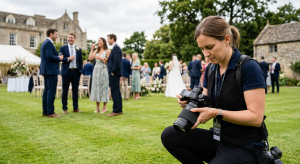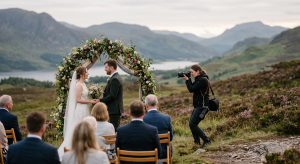
A common misconception regarding event documentation is that a professional simply arrives, presses a shutter release for several hours, and hands over a digital gallery a few weeks later. The reality of professional event capture involves intensive preparation, massive data management, and specialised hardware. It is this underlying technical and logistical architecture that dictates what a properly qualified wedding photographer commands from your overall budget. We will evaluate these services through two specific criteria: the technical resilience of the operator on the day, and the administrative transparency of their post-production process. Judging a supplier solely on a heavily curated social media feed ignores the very mechanisms that guarantee a safe return on your investment.
Quick Summary
Evaluating photography services requires looking past isolated portfolio highlights to assess logistical competence and technical redundancy. The total investment reflects the invisible hours spent in post-production and the hardware required to secure your data.
- Total coverage hours dictate the baseline cost and physical stamina required.
- Secondary shooters provide narrative breadth but introduce stylistic variables.
- Post-production editing requires significantly more time than the physical event.
- True expertise is demonstrated in challenging, low-light indoor environments.
- Failsafe mechanisms and data redundancy are non-negotiable professional standards.
Table of Contents
- 1. Base Coverage Hours
- The reality of full-day stamina and scheduling
- 2. Secondary Shooters and Personnel
- Wider narrative coverage, reduced singular focus
- 3. Post-Production and Image Editing
- The invisible hours that dictate final delivery
- 4. Portfolio Consistency in Difficult Lighting
- Golden hour is easy, dark reception venues demand mastery
- 5. Deliverables and Licensing Rights
- Digital access does not guarantee print permissions
- 6. Equipment Redundancy and Data Security
- Professionalism is defined by failsafes, not primary cameras
- 7. Engagement Sessions and Pre-Consultations
- Excellent for rapport, unnecessary for strict budgets
- Matching Photography Investments to Your Event Priorities
- FAQ
- Recommended Reads
1. Base Coverage Hours
The reality of full-day stamina and scheduling
The most fundamental driver of cost is the contracted time a professional spends on site. Base packages typically range from a half-day format, capturing the ceremony through to the wedding breakfast, up to complete full-day coverage that begins with morning preparations and concludes late into the evening entertainment.
This operates on a strict contractual basis. The operator reserves a specific block of time, and any deviation on the day triggers overtime clauses. The mechanism here is physical bandwidth; managing heavy camera bodies while remaining hyper-vigilant for candid moments imposes a hard limit on human stamina. Understanding how to choose the perfect wedding photographer in 2026 requires mapping their standard package hours directly against your own event itinerary.
The honest limit of extended coverage is the sharply diminishing return of the final hours. Keeping a photographer on site past the first few dances rarely yields valuable additions to your gallery. Once guests are heavily intoxicated and the formal events have concluded, the resulting images are rarely framed or added to albums. Couples facing strict budget constraints should immediately cut the final two hours of evening coverage rather than compromising on the quality of the primary daytime capture.
2. Secondary Shooters and Personnel
Wider narrative coverage, reduced singular focus
Many modern packages include, or offer as an upgrade, a second photographer. This setup is designed for large-scale events or logistical scenarios where the couple prepares in entirely different locations.
A secondary shooter operates under the direction of the primary professional. While the lead focuses on the critical focal points – the bride walking down the aisle, the exchange of rings – the second shooter stands at the periphery, capturing the groom’s reaction or the parents in the front row. The primary business handles all post-production to ensure the final gallery feels unified. When evaluating multiple UK wedding photographer options, checking whether a second shooter is a permanent partner or a casual hire changes the value proposition entirely.
This approach fails when the primary professional subcontracts the role to an unvetted junior operator purely to inflate the package price. If the second shooter uses completely different lens focal lengths or fails to match the primary operator’s framing style, the final gallery will feel disjointed. Skip this add-on entirely if your guest list is small or if your entire event takes place within a single, compact venue where one highly skilled individual can comfortably monitor the room.
3. Post-Production and Image Editing
The invisible hours that dictate final delivery
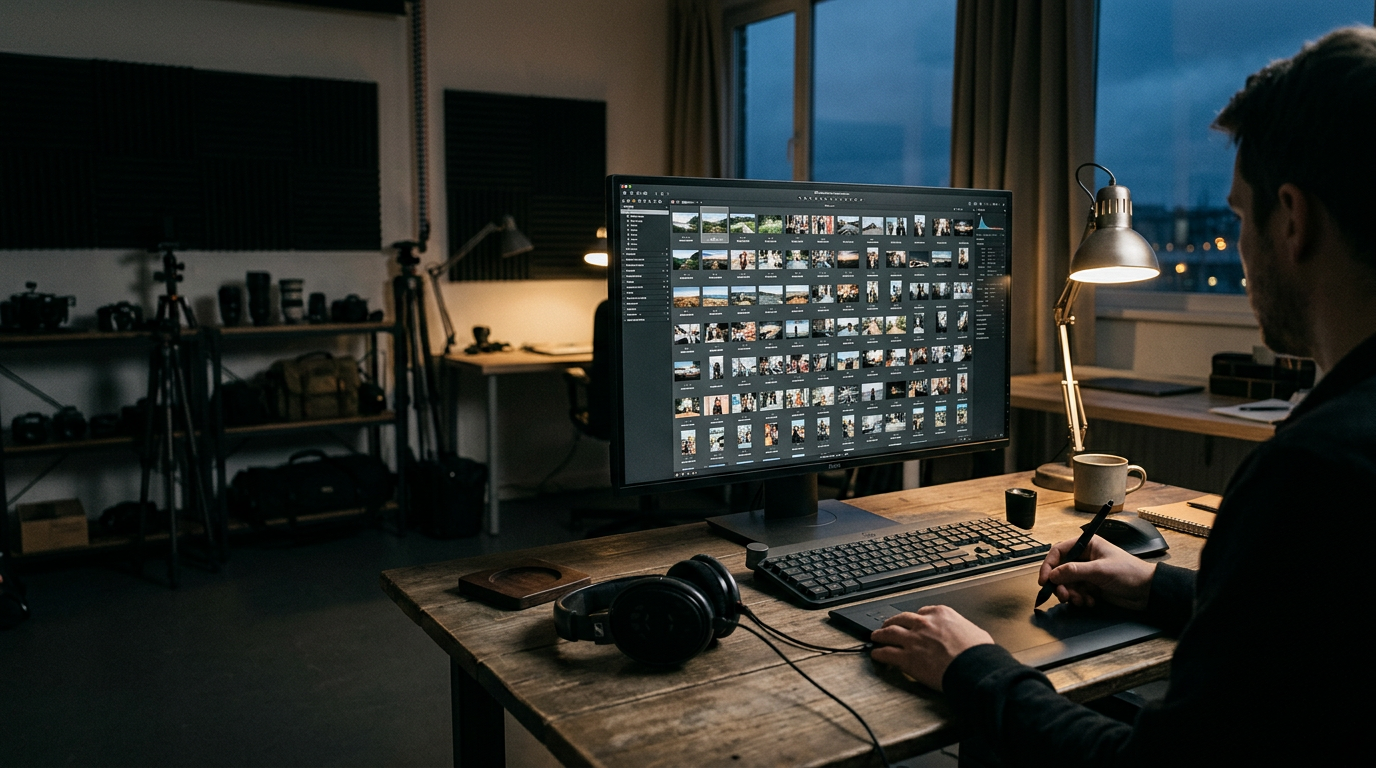
The bulk of your financial investment pays for what happens after the event concludes. Capturing the images is only the raw data collection phase; post-production is where the actual product is manufactured.
The mechanism involves a rigorous workflow: backing up data, culling thousands of raw files down to a manageable narrative of several hundred, and then individually processing each selected file. This grading process involves correcting white balance, recovering shadow detail, adjusting exposure, and applying a consistent colour profile across images taken in drastically different lighting conditions. Using reputable directories of top professional platforms for choosing the right wedding photographer will quickly highlight that the highest-rated operators are those with immaculate, consistent post-production standards.
Detailed retouching falls entirely outside the scope of standard post-production. Standard editing does not include altering physical appearances, removing background objects, or complex composite work. Expecting a professional to digitally iron clothing or remove exit signs from every background shot will result in severe delays and substantial hourly surcharge fees. If you require editorial-level skin retouching, you must explicitly negotiate this scope before signing the contract.
4. Portfolio Consistency in Difficult Lighting
Golden hour is easy, dark reception venues demand mastery
A portfolio curated entirely of sun-drenched, outdoor portraits is a red flag if your event takes place indoors or during the darker months. True technical competence is proven when ambient light fails.
Professionals handle poor lighting through a combination of fast lenses, high-performance sensors, and off-camera flash architecture. In venues like historic Scottish castles or during winter celebrations where the sun sets mid-afternoon, they must construct their own light. This involves placing remote strobe units around a reception room to create depth, allowing them to capture sharp, vibrant images on a dark dancefloor. This technical requirement runs parallel to understanding DJ cost and budgeting for your celebration, where professional room lighting and atmospheric control separate premium operators from amateurs.
Practical rule: Always demand to see a complete, uncurated gallery from an indoor winter event before committing to a contract.
Operators who market themselves exclusively as “natural light photographers” often do so because they do not know how to operate flash equipment. These suppliers fall apart during evening receptions, resulting in grainy, blurred, or completely unusable dancefloor galleries. If your timeline pushes into the evening, skip any supplier who cannot demonstrate a mastery of artificial lighting.
5. Deliverables and Licensing Rights
Digital access does not guarantee print permissions
The physical or digital format in which you receive your images drastically alters the final invoice. Understanding the legal difference between image access and image ownership is vital.
Most professionals deliver a digital gallery via a secure cloud link or an engraved USB drive. However, the mechanism of licensing dictates what you can do with those files. A standard contract grants a “personal use license,” allowing you to share images online and print them for your home. The creator retains the overriding copyright. Similar to the variables determining professional event costs, the physical materials – particularly custom-designed albums – sit outside the base service fee and are subject to commercial markups.
Physical deliverables present a steep financial barrier. Purchasing a physical album directly through the photographer often carries a massive premium. While the binding and paper stock are undeniably superior to consumer printing labs, couples on tight budgets should negotiate for high-resolution, unwatermarked digital files with full printing rights, allowing them to source their own albums at a fraction of the cost at a later date.
6. Equipment Redundancy and Data Security
Professionalism is defined by failsafes, not primary cameras
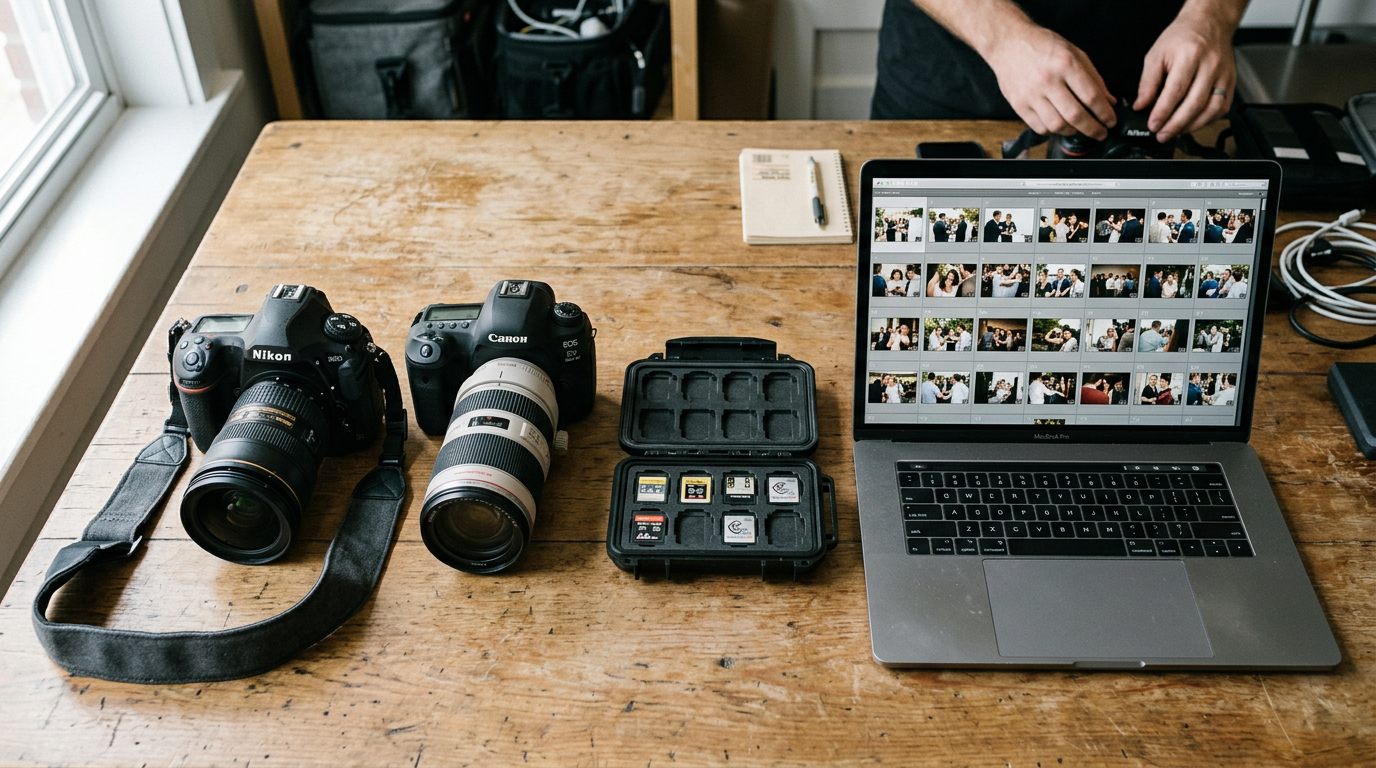
The unseen risk in event documentation is hardware failure. A consumer camera records to a single memory card; if that card corrupts, the data is gone forever.
Professional standard practice relies on immediate redundancy. High-end camera bodies feature dual memory card slots, writing every image to two separate physical locations simultaneously. Upon returning to their office, the operator immediately transfers this data to local RAID storage arrays and separate cloud backups before formatting the field cards. This obsession with risk mitigation is a core component of any comprehensive guide to professional event management.
However, equipment redundancy cannot rescue a poorly planned timeline. If you allocate only ten minutes for formal family portraits, no amount of backup hardware will magically produce a relaxed, comprehensive family gallery. The technical failsafe secures the data, but it requires realistic scheduling from the client to capture that data in the first place.
7. Engagement Sessions and Pre-Consultations
Excellent for rapport, unnecessary for strict budgets
Many premium packages bundle a pre-wedding engagement shoot into the total cost. This serves as a live rehearsal for both parties prior to the main event.
The mechanism is purely psychological. It allows the operator to understand how the couple interacts, which poses feel natural to them, and how they react to being directed. For couples who are highly anxious in front of a lens, this low-stakes environment breaks the ice, meaning that on the actual day of the event, the camera feels far less intrusive.
Despite the marketing, this is an entirely optional luxury. An engagement session drains both budget and weekend availability for an outcome that does not directly impact the documentation of the main event itself. If your budget is stretched, this is the very first line item you should negotiate out of the package. A truly competent professional does not require a practice run to do their job properly on the day.
Matching Photography Investments to Your Event Priorities
Your final choice should align directly with your venue constraints and schedule, rather than purely resting on a preferred editing aesthetic.
If your event is heavily compartmentalised across multiple large venues, prioritise packages that secure a permanent secondary shooter to manage the sheer physical footprint. If your timeline runs heavily into the darker winter evenings, discard the natural light specialists immediately and allocate your budget toward an operator who demonstrates mastery over complex, off-camera flash setups. Conversely, if your budget is the absolute limiting factor, strip away the engagement shoots, the physical albums, and the late-night dancefloor coverage. Secure a highly competent solo professional for the core daylight hours, ensure you secure the full digital printing rights, and handle the physical albums yourself once your finances have recovered.
FAQ
Do photographers provide the RAW, unedited files?
Rarely. RAW files are flat, unfinished data files that require proprietary software to read properly. Supplying them compromises the professional’s quality control, as the editing process is half of their distinct style.
Who owns the copyright to my event photos?
The photographer retains the legal copyright upon creating the image. You are granted a personal use license, which allows you to print and share the images, but prevents you from selling them commercially or submitting them to publications without the creator’s explicit permission.
Why do some professionals charge for travel expenses separately?
Travel beyond a specified radius incurs fuel costs, time out of the office, and potentially overnight accommodation. Keeping these outside the base package prevents local clients from subsidising the travel costs of clients holding events in distant locations.