Why Getting Your Wedding DJ Songs Right Defines the Reception
Stand at the edge of the dancefloor at 9:30 PM, just after the evening food has been cleared. This is the exact moment a reception either locks in its momentum or permanently loses the crowd to the bar. Curating a list of wedding DJ songs is not a matter of simply exporting your daily listening habits; it requires mechanical precision, an understanding of crowd psychology, and a strategy for bridging generational divides across four hours. When couples treat their evening entertainment as a rigid spreadsheet rather than a fluid, reactive performance, they inadvertently engineer their own empty dancefloors.
Quick Summary
Building a professional reception playlist requires balancing personal preferences with the mechanical realities of crowd management and venue limitations. A successful brief provides a framework rather than a minute-by-minute script.
- Map the tempo progression to avoid burning out guests too early.
- Restrict your absolute must-play selections to a maximum of 15 tracks.
- Identify crossover genres that bridge the gap between older relatives and younger friends.
- Use the ‘do not play’ list sparingly to avoid removing vital floor-rescue tools.
- Factor in buffet service times and venue sound limiters before finalising the brief.
Table of Contents
- Why Getting Your Wedding DJ Songs Right Defines the Reception
- Quick Summary
- 1. Treat the Playlist as an Energy Arc
- Front-loading heavy tempos guarantees an empty floor by midnight
- 2. Segregate the Must-Play from the If-Possible
- Over-prescribing tracks strips the DJ of their ability to read the room
- 3. Factor in Demographic Crossover Tracks
- Generational bridge tracks prevent isolating older guests early in the evening
- 4. Define the Do Not Play List with Precision
- Vanity bans remove reliable floor-rescue tools when momentum drops
- 5. Account for Venue Logistics and Timings
- Ignoring the buffet window results in wasted peak-time selections
- Common Pitfalls & Troubleshooting
- FAQ
- Recommended Reads
1. Treat the Playlist as an Energy Arc
A standard reception spans roughly four hours, moving from the polite formality of the first dance to a high-energy finale. Structuring the music for this window requires a deliberate manipulation of tempo and intensity, known in the industry as building an energy arc.
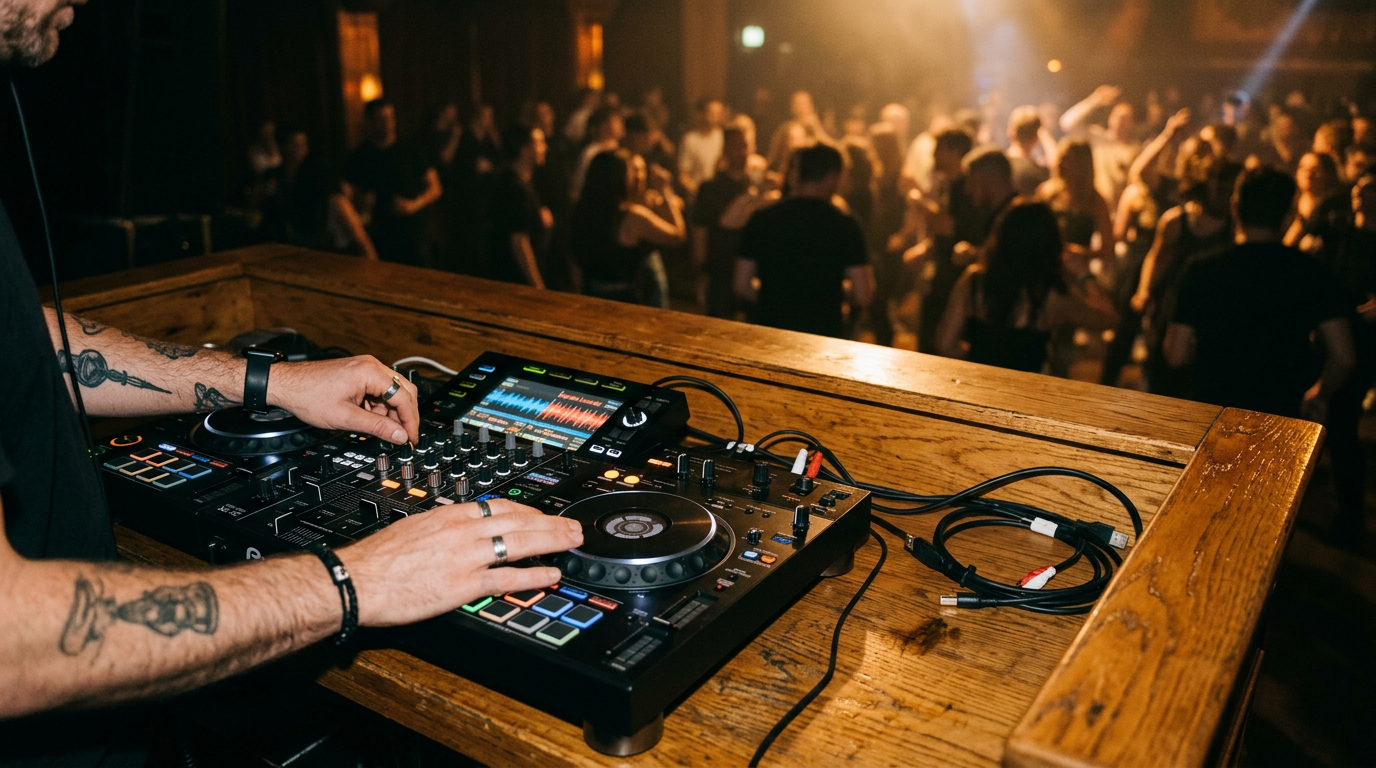
Front-loading heavy tempos guarantees an empty floor by midnight
Couples often map out their evening carefully. They frequently review top wedding DJ songs and curation strategies for an unforgettable 2026 celebration to understand how tempos naturally shift over four hours. A mechanical error often happens next. Hosts request heavy club anthems at 128 beats per minute immediately after the first dance. At 8:00 PM, older relatives are still seated. Evening guests are just arriving and greeting each other. Playing peak-hour dance tracks in this window brings two negative outcomes. It alienates the older demographic who find it abrasive. It also exhausts the younger demographic long before the final hour.
To manage this arc properly, categorise your requests by tempo and time of day. Early evening requires 90 to 110 BPM tracks – familiar, rhythmic singalongs that invite movement without demanding intense physical exertion. As the ambient lighting drops and alcohol consumption increases, the tempo can naturally scale up toward 120 BPM and beyond. You can check your own draft playlist today by sorting the tracks by their release decade and tempo; if your heaviest tracks are clumped at the top of the list, your evening will peak too early and flatline by 10:30 PM.
2. Segregate the Must-Play from the If-Possible
The mathematical reality of a four-hour set is absolute. At an average of three minutes per track with tight mixing overlaps, the physical limit of the evening is roughly 75 to 80 songs.
Over-prescribing tracks strips the DJ of their ability to read the room
Understanding the 8 essential factors to consider for wedding DJ hire in 2026 requires looking closely at how much flexibility you grant the performer. The most damaging brief a couple can hand over is a spreadsheet containing 150 mandatory tracks. When a professional is locked into a rigid sequence, they cannot deploy reactive mixing. If a requested indie track clears the floor, a restricted DJ cannot immediately pivot to a universally loved Motown classic because they are contractually bound to play the next indie track on the spreadsheet.
Practical rule: Limit your ‘must-play’ list to exactly 15 tracks, representing roughly 20% of the evening’s total playtime, leaving the remaining 80% for the DJ to adapt to the room in real time.
To implement this, create a tiered system. Tier one contains the 15 absolute non-negotiables: the first dance, the final song, and the core anthems you and your closest friends expect. Tier two contains 30 ‘if-possible’ tracks that give the DJ a clear picture of your musical identity, which they can draw from when the mood suits. Everything else should be left to professional judgement.
3. Factor in Demographic Crossover Tracks
A wedding is one of the few environments where you will find four distinct generations sharing the same entertainment space. Your playlist must account for the mechanical overlap between these demographics, known as the crossover.
Generational bridge tracks prevent isolating older guests early in the evening
Integrating different generations on the floor is a core principle detailed in a complete guide to professional event hire for seamless occasions in 2026. A crossover track is one that appeals simultaneously to the 65-year-old relative who bought the record on vinyl and the 25-year-old friend who knows it from a recent film soundtrack. Genres like 80s synth-pop, classic Motown, and certain 90s anthems act as bridge material.
The failure mode here is falling into a niche bottleneck. If you mandate 45 minutes of obscure 2000s pop-punk, you will likely create a scenario where eight of your closest friends are jumping in the centre of the room while the remaining ninety guests leave the floor. Once the majority of the room sits down and disengages, winning their attention back requires immense effort. Review your primary requests to ensure you have identified at least three distinct decades that can serve as bridges between your personal tastes and the broader crowd’s tolerance.
4. Define the Do Not Play List with Precision
The ‘do not play’ list is a powerful tool designed to protect the atmosphere from tracks associated with bad memories, ex-partners, or strictly inappropriate explicit lyrics. However, it is frequently misused as an exercise in musical snobbery.
Vanity bans remove reliable floor-rescue tools when momentum drops
When you are evaluating 4 UK wedding DJ packages for your 2026 celebration, check if the provider allows for customisation of this strict boundary, but use that power wisely. A vanity ban occurs when a couple bans universally successful artists – such as ABBA, Neil Diamond, or The Killers – simply because they consider them cliché.
These tracks are considered cliché specifically because they possess a proven, mechanical ability to fill a dancefloor. When the energy dips at 10:15 PM and the floor begins to scatter, a professional relies on these universal hits as emergency rescue tools to restart the room. If you have banned every reliable party anthem, you leave the DJ with no mechanism to recover the crowd. To audit your own boundaries today, look at your ‘do not play’ list and ask yourself: are you banning this track because it causes genuine distress, or simply because you want to appear musically sophisticated? If it is the latter, remove the ban.
5. Account for Venue Logistics and Timings
Music does not exist in a vacuum; it interacts with the physical dimensions of the room and the logistical timeline of the venue staff. A perfectly curated setlist will fail if it collides with a poorly timed buffet or a strict environmental health regulation.
Ignoring the buffet window results in wasted peak-time selections
If your venue layout pushes the bar into a separate room, adding external entertainment – such as one of the 7 professional photo booth rental services for your 2026 event – can keep guests anchored near the main performance space. However, the most destructive logistical clash is the evening food service. If you do not provide your DJ with the exact caterer schedule, they may drop your highly requested, peak-energy floor-filler at the exact moment the venue announces the bacon rolls. The floor will immediately empty, and your favourite track will be wasted on an empty room.
Furthermore, modern venues increasingly employ sound limiters – environmental devices that cut the power if the decibel level exceeds a set threshold. These limiters are particularly sensitive to low-end sub-bass frequencies. If your playlist is dominated by heavy dance or R&B tracks, the DJ must actively apply high-pass filters to remove the sub-bass, fundamentally altering how the tracks sound. You must check with your venue coordinator today to confirm whether a sound limiter is installed, and immediately pass that information to your entertainment provider.
Common Pitfalls & Troubleshooting
Resolving these technical bottlenecks is a major component of the 7 variables determining your professional wedding DJ cost in 2026, as experienced professionals charge specifically for their ability to diagnose and rescue a failing room.
The Rigid Spreadsheet Failure (Most Common Real Cause)
* Symptom: The music playing is exactly what you requested in your brief, yet the dancefloor remains sparsely populated and guests are beginning to leave early.
* Fix: The couple must approach the booth and explicitly release the DJ from the rigid playlist. Verbally grant them permission to abandon the requested sequence and pivot to reactive mixing based on real-time crowd responses.
The Post-Buffet Lull
* Symptom: A previously packed floor empties rapidly as the evening food is announced, and the momentum fails to recover after guests have eaten.
* Fix: The DJ must immediately drop the tempo and volume to ambient, familiar singalongs during the service. Once eating concludes, the room must be completely rebuilt using highly familiar, cross-generational bridge tracks rather than instantly forcing heavy dance anthems onto a digesting crowd.
The Sound Limiter Trip
* Symptom: The music completely cuts out mid-song, followed by a 10-second silence before the system abruptly reboots.
* Fix: The DJ must locate the venue’s ambient decibel meter (usually a traffic-light system on the wall) and manually apply EQ filters to roll off the sub-bass frequencies on their mixer, as low-end rumble triggers limiters far faster than high-end vocals.
The Niche Bottleneck
* Symptom: A small, hyper-engaged group of eight friends is dominating the centre of the floor, while ninety other guests have retreated to their seats or left the room entirely.
* Fix: The performer must mix out of the niche genre within a maximum of two tracks. They must select a universally recognised transition song that acknowledges the energy of the small group while widening the appeal enough to draw the seated guests back in.
FAQ
How many songs should we choose for our DJ?
Provide a strict maximum of 15 absolute “must-play” tracks, and an additional 20 to 30 “if-possible” tracks to indicate your general taste. Since a four-hour set only accommodates about 80 songs in total, providing fewer mandatory tracks gives the professional the essential flexibility they need to read and react to the dancefloor.
What if a guest requests a track on our ‘do not play’ list?
A professional will always politely decline the request, usually by explaining that they do not have the track available or that the couple has specifically requested a different direction for the evening. Your boundaries will be respected without causing friction with your guests.
How do professionals handle explicit lyrics at family-attended weddings?
Most providers hold radio-edited versions of popular tracks specifically for early evening play. If a highly requested track contains unavoidable explicit content, it is generally held back until the final hour of the night, long after older relatives and young children have left the venue.
When is the best time to schedule our first dance?
The optimal window is immediately after the evening guests have arrived and settled, but crucially, well before the evening buffet is served. Scheduling it around 8:00 PM to 8:30 PM acts as a clear, official opening to the party and transitions the room from the formal daytime atmosphere into the evening celebration.