
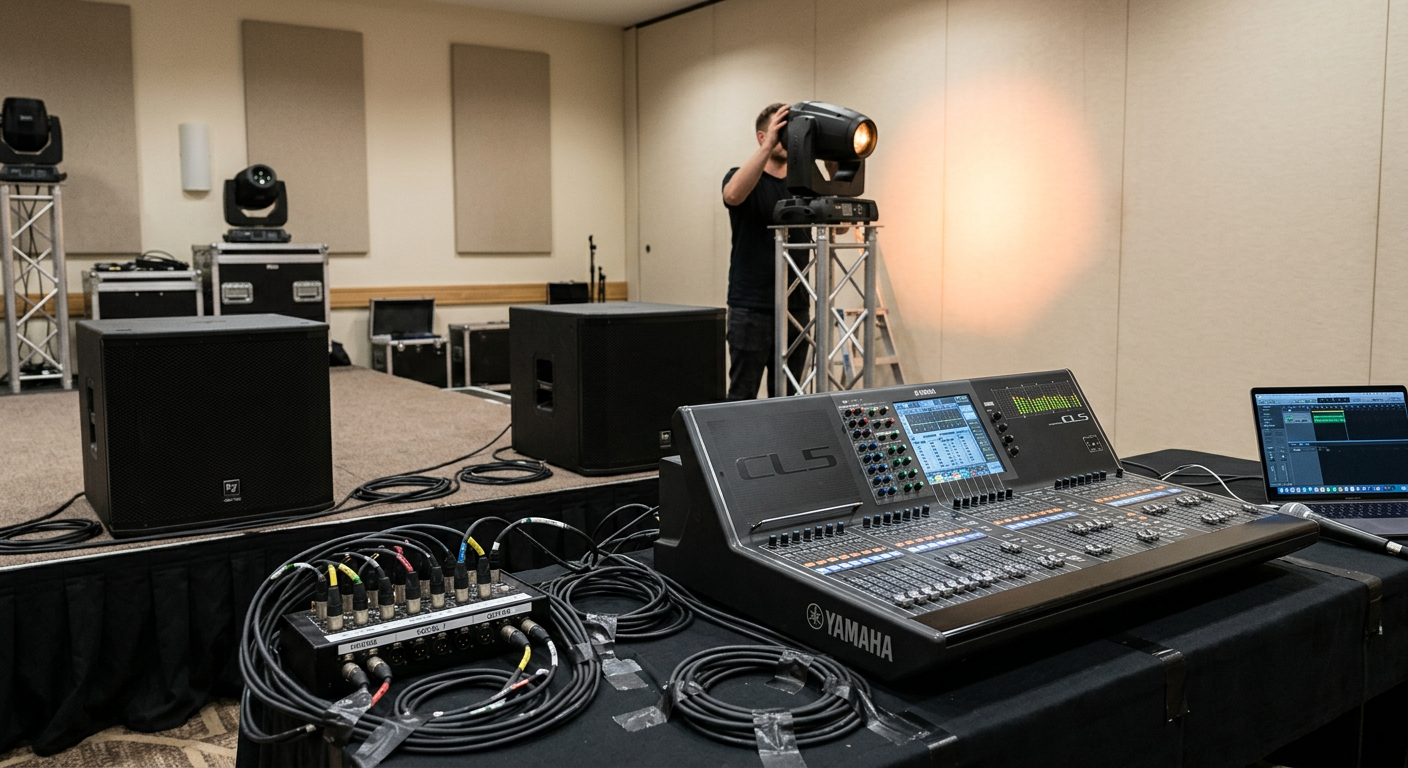
Staring at an empty hotel function room at 8:00 AM on the day of a major corporate summit reveals a harsh truth. The state-of-the-art in-house audio system the venue coordinator promised is usually just a pair of ceiling speakers designed for background ambiance. They are entirely inadequate for a keynote address delivered to 200 guests. Closing this gap between what a venue provides by default and what a professional occasion actually demands is the core purpose of event hire. Securing the correct technical infrastructure – from active subwoofers and DMX lighting universes to interactive guest experiences – prevents immediate, highly visible failures. The technical choices made months before the event dictate whether a room feels immersive and celebratory or sterile and disjointed. This guide dismantles the mechanics of specifying, sourcing, and sequencing the equipment that underpins successful occasions.
Quick Summary
Professional equipment sourcing bridges the gap between basic venue provisions and the demanding technical requirements of live occasions. Success requires auditing the physical space before selecting hardware, separating audio intelligibility from visual atmosphere, and rigorously enforcing load-in schedules to prevent supplier bottlenecks.
- Audit before specifying: Request electrical schematics to avoid overloading domestic ring mains.
- Scale audio to bodies: Specify PA systems based on headcount, not just room dimensions, as bodies absorb sound.
- Unify colour temperatures: Use DMX controllers to ensure hired lighting matches the desired aesthetic.
- Protect the load-in: Enforce a strict 60-minute buffer between soundcheck completion and guest arrival.
Table of Contents
- 1. Audit the Venue’s Baseline Capabilities for Event Hire
- Why the Floor Plan Dictates the Order
- 2. Specify the Foundational Audio Equipment
- Why Bodies Absorb Sound and Ruin the Mix
- 3. Layer Lighting and Visual Enhancements
- Where Uncontrolled Colour Temperatures Destroy the Atmosphere
- 4. Integrate Interactive Entertainment
- Why Isolated Interactive Zones Fail
- 5. Coordinate Logistics and Supplier Timing
- How Shared Service Lifts Derail the Schedule
- Common Pitfalls & Troubleshooting
- FAQ
- Recommended Reads
1. Audit the Venue’s Baseline Capabilities for Event Hire
Why the Floor Plan Dictates the Order
A venue coordinator’s primary job is to sell the space, not to guarantee the technical success of a bespoke wedding setup or a corporate roadshow. The first step in securing equipment is mapping the hard physical limits of the room. This begins with identifying the exact electrical provision. A standard UK hotel function room often relies on domestic 13-amp sockets shared across a single, continuous ring main. If the catering team plugs in a commercial water boiler on the exact same circuit used by the DJ’s active subwoofers, the breaker will trip instantly when the system demands peak power.
You must also assess the acoustic environment before committing to hardware. Rooms featuring extensive floor-to-ceiling glass, polished concrete floors, and low ceilings create a highly reverberant field. This acoustic reflection turns amplified speech into an unintelligible echo. Knowing this baseline dictates whether you specify a handful of large point-source speakers or multiple smaller, distributed delay speakers placed evenly throughout the room.
The most frequent mistake at this early stage is trusting the phrase “we have an in-house PA.” An integrated system designed strictly for background music and basic announcements will immediately clip and distort under the dynamic range required for a live DJ set. Navigating How to Source Reliable Professional Event Hire in 2026 begins long before looking at supplier inventories; it starts with requesting the venue’s electrical schematic and walking the load-in route. You must measure service lift dimensions, ramp gradients, and door widths, as these physical barriers definitively dictate the size of the flight cases that can actually enter the room.
2. Specify the Foundational Audio Equipment
Why Bodies Absorb Sound and Ruin the Mix
Audio requirements scale aggressively in direct proportion to headcount. Human bodies absorb high frequencies, meaning a sound system that feels overwhelmingly loud in an empty room during a morning soundcheck will sound muffled, weak, and distant once 200 guests occupy the floor. Proper foundational audio specification requires separating the demands of speech intelligibility from the demands of musical frequency response.
For speeches, specify cardioid microphones. These units actively reject sound entering from the rear and sides, drastically reducing the risk of a high-pitched feedback loop when presenters step in front of the primary speakers. For music playback, specify active speaker systems. In an active setup, the amplifier is built directly into the wooden cabinet and precisely matched to the driver’s power handling capabilities. This eliminates the impedance mismatch risks commonly associated with older, passive amplifier racks.
The failure mode here is under-speccing the low-end frequencies. Planners frequently hire two standard 12-inch top speakers, assuming that is sufficient for a large private party. While this setup manages higher register vocals adequately, it lacks the physical cone size to move enough air for kick drums and bass lines, resulting in a thin, fatiguing sound.
Practical rule: Specify one dedicated subwoofer for every 75 guests if the event involves a dedicated dance floor, regardless of the room’s maximum stated capacity.
Technical execution dictates the final result; researching How to Curate the Perfect Playlist for a Professional DJ for Corporate Events in 2026 is ultimately irrelevant if the hired sound system cannot deliver clear, full-spectrum audio to the guests standing at the back of the room.
3. Layer Lighting and Visual Enhancements
Where Uncontrolled Colour Temperatures Destroy the Atmosphere
Lighting directly dictates human behaviour within an event space. Bright, static overhead lighting signals that a gathering is formal or concluding, while dynamic, heavily saturated lighting draws guests toward a dance floor and encourages celebration. Professional equipment hire moves far beyond basic illumination into total atmospheric control.
The mechanics rely heavily on DMX (Digital Multiplex) controllers. A standard DMX universe allows a lighting engineer or professional DJ to assign specific data addresses to individual fixtures. This means the room uplighting can remain a static, elegant amber during a seated wedding breakfast, then instantly transition into a coordinated, sound-active chase sequence for the evening reception. Modern setups utilise wireless DMX transmitters, which eliminate the trip hazards of running long, taped-down cables across guest walkways and emergency fire exits.
The primary mistake planners make is mixing colour temperatures haphazardly. Combining stark, clinical white LED moving heads with the warm, halogen chandeliers of a heritage venue creates a visual clash that ruins professional event photography. Every hired fixture must be calibrated to a cohesive colour palette. Furthermore, while premium visual packages inevitably influence the 7 Variables Determining Your Professional Wedding DJ Cost in 2026, they return outsized value by completely transforming sterile environments. Additions like custom monogram projection require precise focal length calculations based on the throw distance from the fixture lens to the wall; guessing this measurement results in a blurred, distorted, and unreadable image.
4. Integrate Interactive Entertainment
Why Isolated Interactive Zones Fail
Interactive elements serve as vital secondary focal points. They provide a structured activity for guests who prefer to avoid the main dance floor, actively extending the duration those guests remain at the event. The most common iteration is the compact, touchscreen photo booth or #SelfiePod.
Operating these devices requires specific infrastructural support. A modern pod relies on a continuous Wi-Fi connection to process digital galleries, apply branded graphic overlays, and instantly transmit captures to users via email or text message. If the venue’s guest network uses a captive portal that automatically times out every 60 minutes, the booth will silently fail to send images, resulting in frustrated users and a massive backlog of unsent data. The mechanics also involve managing ambient light spill; placing a booth directly beneath a harsh venue spotlight washes out the unit’s internal ring light, ruining the exposure and contrast of the photographs.
The most frequent mistake is isolating the interactive zone entirely. Planners often banish photo booths to distant hallways or adjacent reception rooms to save floor space in the primary hall. Out of sight means out of mind, and an isolated booth will see a fraction of its potential engagement. Referencing detailed industry resources like Choosing the Right Photo Booth Rental for Your Event: A 2026 Guide helps match the specific hardware footprint to the floor plan. This ensures the unit sits on the periphery of the main action, where it remains highly visible but does not impede the flow of foot traffic or block essential fire exits.
5. Coordinate Logistics and Supplier Timing
How Shared Service Lifts Derail the Schedule
High-end equipment is entirely useless if it is still sitting in a transit van in the loading bay when the first guests arrive. Venue load-ins are notorious logistical bottlenecks, often featuring a single, slow-moving service lift that must be shared simultaneously by caterers, florists, and heavy production crews.
Managing this chaos requires staggered arrival times and a rigid hierarchy of installation. Heavy audio rigs, subwoofer cabinets, and lighting totems must be loaded in and positioned before delicate dining tables are laid out. Attempting to wheel a 50kg subwoofer case past fully set tables risks catastrophic damage to glassware and tableware. Additionally, UK venues mandate strict compliance checks before any external equipment is connected to their mains power. Suppliers must produce current Portable Appliance Testing (PAT) certificates for every single plug and valid Public Liability Insurance (PLI), typically requiring a strict £10m limit. Failing to submit these documents to the venue manager 48 hours prior to the event routinely results in the supplier being denied entry at the door.
The operational mistake is ignoring the complexities of the room flip. If a single space serves as both the afternoon dining room and the evening reception area, suppliers must execute a rapid transition while guests are temporarily moved to a bar area. Mastering The Mechanics of Professional Event Management for Large Gatherings in 2026 requires ruthlessly protecting these load-in schedules. Demand a minimum 60-minute buffer between the completion of the technical soundcheck and the doors opening to the public.
Common Pitfalls & Troubleshooting
Event technology fails in highly predictable ways. Diagnosing the root cause rapidly prevents a minor technical glitch from escalating into a noticeable disruption.
The Drop-Out Microphone
* Symptom: The wireless microphone crackles, cuts out entirely during a critical speech, or picks up sudden interference from local taxi radios.
* Cause: The microphone receiver is operating on a congested Radio Frequency (RF) band, competing directly with other broadcast devices in the building. It is rarely a simple battery failure.
* Fix: Never turn on a wireless microphone and blindly assume it works. The supplier must run an active RF scan using the receiver’s built-in software to locate a clean, unoccupied frequency block before the event begins, particularly in densely populated urban venues.
The Tripped Breaker
* Symptom: The entire audio and lighting rig loses power the exact moment the event transitions to high-energy, bass-heavy music.
* Cause: The combined continuous power draw of the amplifiers and lighting fixtures exceeded the rating of a single 13-amp domestic circuit, overloading the breaker.
* Fix: Map the venue’s ring mains during the initial site visit. Run lighting fixtures and audio equipment on completely separate circuits, pulling power from different walls of the room to ensure they are on different breakers.
The Empty Dance Floor Despite a Packed Room
* Symptom: Guests are actively engaged in conversation at the edges of the room but refuse to step onto the dance floor, despite a highly appropriate musical selection.
* Cause: The venue’s house lighting remains fully illuminated, or the hired wash lighting is overly bright and static. People feel exposed and self-conscious under stark lighting. This is the most often the real cause of a failed atmosphere.
* Fix: Dim the venue’s chandelier or overhead lighting to 10% capacity. Rely entirely on the hired dynamic, DMX-controlled lighting to define the space, using deep, saturated colours like magenta and navy to lower the perceived visibility on the floor.
The Distorted Low-End
* Symptom: The music sounds aggressive, muddy, and physically uncomfortable to listen to, even at moderate room volumes.
* Cause: The DJ or sound engineer has pushed a mid-tier PA system past its limiting threshold, causing the amplifier to clip the audio signal.
* Fix: Reduce the input gain on the main mixing desk. The correct solution to a quiet room is hiring a larger PA system with higher headroom, not pushing a small system into aggressive, damaging distortion.
FAQ
Do I need to hire an external PA if the venue provides a sound system?
Yes, in almost all cases involving live music or a professional DJ. Venue systems are typically 100-volt line ceiling installations designed exclusively for background ambient music and voice announcements. They lack the low-frequency drivers required to reproduce the bass frequencies of party music and will distort immediately if pushed to dance floor volumes.
What electrical certifications do event suppliers need in the UK?
Any professional supplier bringing electrical equipment into a hired venue must hold valid Portable Appliance Testing (PAT) certification for every item connected to the mains. Additionally, they must carry Public Liability Insurance (PLI), with most established hotels and historic venues demanding a minimum coverage limit of £10 million.
How much setup time should I allocate for lighting and audio?
A standard professional setup involving a high-quality PA, DMX-controlled moving heads, and a secondary interactive element like a photo booth requires an absolute minimum of 90 minutes from the moment the supplier enters the room. Large-scale setups require three to four hours. Always factor in the physical transit time from the loading bay to the actual function room.
Can interactive elements operate without venue Wi-Fi?
Most modern photo booths and social media pods require internet access to transmit digital captures. While many systems queue files locally to send later if the connection drops, instant sharing requires a stable network. If a venue has poor Wi-Fi or cellular dead zones, the supplier must bring an independent 4G/5G router on a major network carrier.
Pingback: A Complete 2026 Strategy for Sourcing Large-Scale Event Hire Equipment – JP the DJ