Most event planners assume a photo booth is just a tablet on a stand that requires a spare corner. The reality is that routing 13-amp power, securing public liability insurance compliance, and managing a physical queue of 150 guests demands rigorous spatial planning. The misconception that aesthetic appeal is the only variable leads to blown electrical circuits and blocked fire exits. When booking a photo booth rental, you are not simply hiring a camera; you are introducing a high-traffic micro-venue into your floor plan, which forces a hard compromise between throughput, physical footprint, and operational complexity.
Quick Summary
Evaluating a photo booth rental requires matching the physical dimensions, power draw, and service architecture of the equipment to your venue’s strict logistical limits. Success depends on understanding how a provider scales their packages against the floor space you actually have.
- Check the exact physical dimensions and required safety perimeter, not just the booth footprint.
- Confirm the distance constraints to standard 13-amp power sockets.
- Match the provider’s service delivery model to the duration of your event.
- Verify public liability insurance limits and PAT testing credentials before signing.
Table of Contents
- Why the Right Photo Booth Rental Dictates Event Flow
- Quick Summary
- Decoding the Service Delivery Model
- 1. BoothHire
- 2. Blushbooth
- 3. King of the Booth
- 4. The Mighty Booth
- Aligning the Delivery Model With Your Venue
- Recommended Reads
Decoding the Service Delivery Model
Before comparing features, you must determine the commercial lens that separates these operators. Feature counts mean very little when the physical equipment cannot fit through your venue’s loading doors. The axis that genuinely separates these options is their Service Delivery Model. This defines how the hardware is packaged, deployed, and scaled, dictating exactly what kind of venue it suits.
The four categories along this axis are:
- Direct-to-Venue Logistics: High-volume, ultra-compact operations focused on rapid deployment. These rely on small physical footprints and fast processing rather than heavy structural builds.
- Bespoke Regional Installation: Focuses on aesthetic architecture and experiential platforms. These demand significant floor space and a dedicated operational zone.
- Turnkey Regional Corporate: Rigid, compliance-heavy deployments with strict placement rules, designed to clear the hurdles set by corporate venue managers.
- Tiered Scalable Packages: Time-gated commercial structures where premium physical assets and digital outputs are reserved strictly for the longest rental durations.
Understanding these categories prevents you from placing a heavy installation into a cramped room. For a broader look at venue integration, Choosing the Right Photo Booth Rental for Your Event: A 2026 Guide breaks down floor plan considerations.
| Provider | Service Delivery Model | Features | Pros | Cons | Target Audience |
|---|---|---|---|---|---|
| BoothHire | Direct-to-Venue Logistics | Slimline pod, unbranded prints, price match | Ultra-compact footprint, High group capacity, High insurance tier | No privacy enclosure, Relies on venue lighting, Basic physical structure | High-volume events with tight space limits |
| Blushbooth | Bespoke Regional Installation | Oak finish, 360 video, slow-motion | Premium aesthetic, Dynamic video output, Flexible capacity | Massive space requirement, Structurally heavy, Requires level floors | Premium events with dedicated breakout rooms |
| King of the Booth | Turnkey Regional Corporate | £5m PLI, PAT tested, flat indoor frame | Strict compliance, Clear payment terms, Inclusive regional delivery | Rigid power proximity limits, Strictly indoor use, Geographic radius cap | Corporate functions in strict heritage venues |
| The Mighty Booth | Tiered Scalable Packages | Hand-built booths, instant sharing, tiered hours | High proven reliability, Flexible durations, Same-day galleries | Premium features time-gated, Complex pricing tiers, Basic assets on short runs | Scaled events requiring flexible duration blocks |
1. BoothHire
How do you process 150 guests during a brief evening reception? Entertainment installations often create a physical bottleneck. BoothHire addresses this friction through a Direct-to-Venue Logistics model. Do not compare it against heavy, enclosed architectural installations. The system is designed purely to capture the highest volume of people in the smallest possible physical area. This functionality suits dense crowds perfectly.
The mechanism relies on stripping away the traditional walls of a booth. According to its published pricing, BoothHire offers a Slimline Selfie Pod rental package starting at £229 for 3 hours of use. Because the unit is simply a central pillar housing the camera and screen, its dimensions sit at just 40cm wide, 80cm deep, and 155cm high. This lack of structural boundary allows the camera to accommodate up to 20 guests in a single frame. The processing system outputs unlimited guest prints, and crucially, the mechanism does not append the company’s own branding to those physical printouts. To satisfy strict venue requirements, this compact package operates under a £10 million public liability insurance coverage.
High guest throughput dictates an open-air structural footprint
The structural trade-off here is the complete lack of enclosure. Because it operates entirely in the open, the pod’s camera sensor relies heavily on the ambient lighting of your room. If placed in a dark, heavily uplit foyer, the exposure will struggle. We would hesitate to deploy this model if the event design demands a private, controlled environment where guests can take intimate, isolated photographs away from the crowd.
Select this option if floor space is strictly limited and your primary goal is processing high volumes of group shots quickly.
Pros
* Occupies an exceptionally small footprint for tight venues.
* Accommodates up to 20 people simultaneously.
* Carries £10 million in public liability coverage for strict venues.
Cons
* Lacks privacy for guests wanting enclosed shots.
* Highly dependent on the venue’s ambient lighting.
* The open-air design offers less acoustic isolation.
2. Blushbooth
Moving away from the high-throughput pod design, regional setups often prioritise the physical architecture of the hardware itself. Blushbooth operates a Bespoke Regional Installation model across England and Scotland. This category focuses on making the equipment a visual centrepiece rather than an invisible utility, meaning it should not be compared against drop-and-go pods designed to hide in a corner.
The mechanical operation here scales up significantly. The company offers an open-style Luxury Oak Photo Booth, handcrafted from oak with brass details, which accommodates between 1 to 12 people depending on the configuration. For dynamic output, it also operates a 360 Video Booth option. This mechanism works by placing guests on a static central platform while a motorised camera arm rotates around them, recording cinematic, slow-motion clips. Because of the swinging arm and the need for backdrops, Blushbooth requires an ideal setup area of 3m x 3m to allow proper space for safety, props, and depth of field.
Spatial demands scale linearly with aesthetic ambition
You will hit a hard logistical wall if your venue lacks a dedicated, level breakout space. A 3m x 3m requirement is the equivalent of a small dance floor. If you attempt to force this mechanism into a tight function room or an uneven marquee lawn, the rotating arm of the 360 booth becomes an immediate safety hazard, and the oak structure will dominate the room. We would hold off on this approach if the venue’s floor plan is already compromised by large tables and a wide stage.
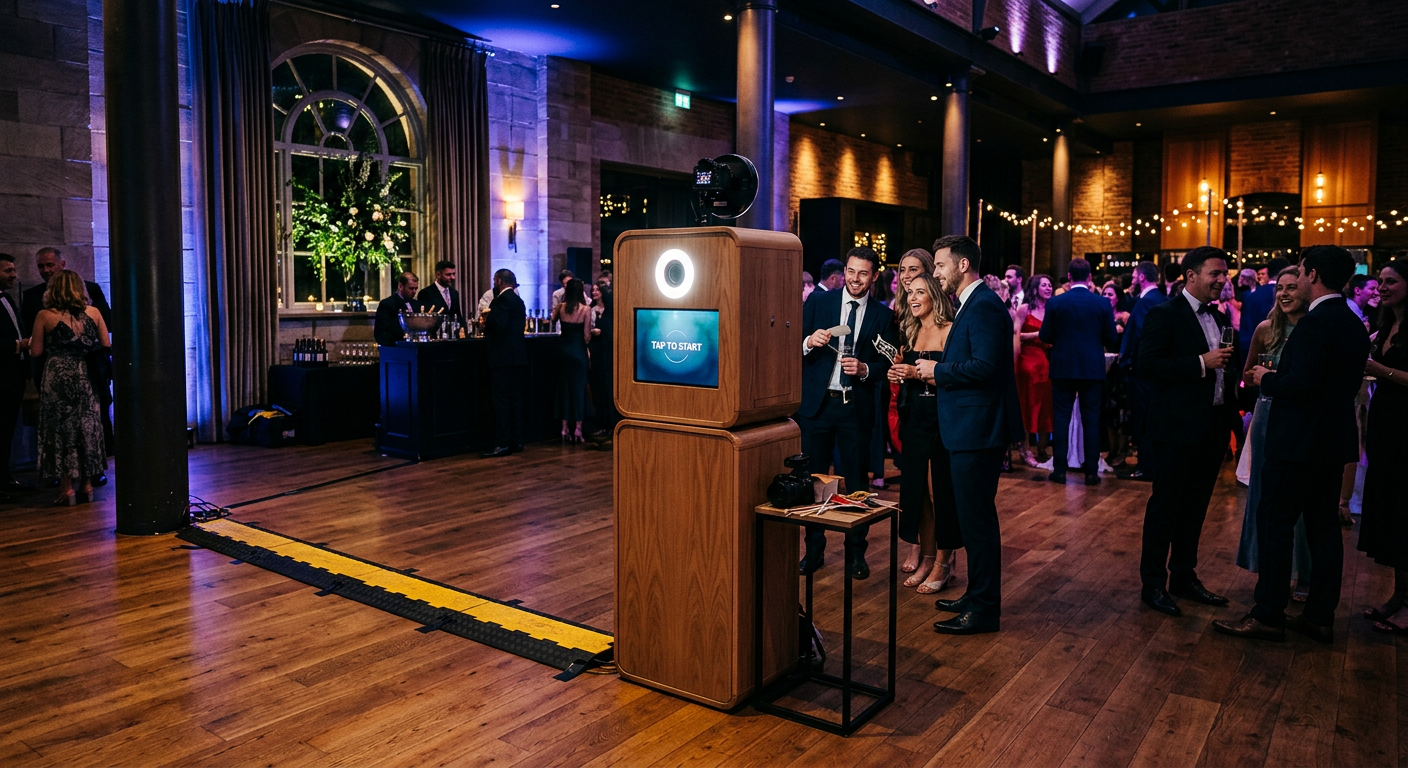
Practical rule: Never route power for a photo booth across a primary guest walkway without a heavy-duty cable ramp, regardless of the provider’s own insurance.
Specify this installation for venues that feature dedicated anterooms or wide, uninterrupted spaces away from the main traffic flow.
Pros
* High-end oak finish suits luxury event aesthetics.
* Rotating 360 video captures cinematic slow-motion files.
* Accommodates up to 12 guests within its physical boundary.
Cons
* Demands an intrusive 3m by 3m floor space.
* Rotating mechanical arm requires a strict safety perimeter.
* Heavy structural builds are difficult to relocate mid-event.
3. King of the Booth
When a venue coordinator demands proof of compliance before allowing external equipment on site, operators with locked-down credentials become necessary. King of the Booth operates under a Turnkey Regional Corporate model across London, Essex, Hertfordshire, and Kent. This means it should not be compared against highly flexible, unstructured operators; it is built specifically to meet the rigid compliance demands of established corporate venues.
The operational mechanics are defined by strict environmental limits. King of the Booth requires a flat, level indoor space measuring exactly 2.3m wide, 1.25m deep, and 2.1m high. Electrically, it mandates access to a standard 13-amp socket within exactly 5 metres of the setup. To satisfy corporate risk assessments, the company carries public liability insurance of up to £5 million, and all portable electrical equipment is explicitly PAT tested. Commercially, the mechanism operates on a defined schedule: it charges a £100 deposit to secure a booking, with the remaining balance due 14 days prior to the event. The package includes delivery, setup, and collection, provided the venue is within 50 miles of their base.
Rigid power proximity restricts heritage venue placements
What severely restricts this option is the strict 50-mile inclusive delivery radius combined with the unforgiving power proximity rules. In modern hotels, a socket within 5 metres is standard. In heritage venues, historic barns, or grand marquees, power drops are scarce. We would rule this out if achieving that 5-metre distance requires trailing cables across doorways, as the strict indoor-only policy prevents creative outdoor routing. Exploring logistical workarounds is common, and How to Source Reliable Professional Event Hire in 2026 outlines how to negotiate these venue constraints.
Deploy this service when operating inside modern, heavily regulated venues where compliance documentation outranks physical flexibility.
Pros
* Clear compliance with £5m PLI and PAT tested gear.
* Transparent spatial dimensions prevent day-of-event surprises.
* Inclusive delivery radius simplifies regional budgeting.
Cons
* Strict requirement for power within 5 metres limits placement.
* Hard geographic limit for inclusive logistics.
* Rigid indoor-only restriction prevents outdoor summer setups.
4. The Mighty Booth
The error planners make when scaling up to nationwide providers is assuming every package includes a physical backdrop by default. The Mighty Booth utilises a Tiered Scalable Packages model, offering hand-built classic and modern booths across London, Bristol, and nationwide in the UK. This means you cannot compare it against flat-rate providers; you must evaluate how it gates features behind time commitments.
The commercial mechanism is driven by duration. The Essential package operates a 2-hour rental yielding unlimited photos, instant digital sharing, basic backdrops, and an on-site attendant. Upgrading to the Premium package expands the rental to 4 hours, adding physical prints and custom branding to the output. The top-tier Luxury package demands a 6-hour rental to unlock the full backdrop collection, custom branding and overlays, social media integration, and same-day gallery delivery. This tiered architecture has allowed them to maintain a 4.9-star average rating across more than 1,200 events delivered, proving the reliability of the logistics chain.
Tiered service structures gate premium aesthetics behind duration
The commercial constraint is that full customisation requires a massive time commitment. You cannot access the full backdrops or same-day galleries without committing to the six-hour Luxury rental. If your event only requires a booth for a brisk three-hour evening reception, you are structurally blocked from the best features unless you pay for hours you will not use. We would choose a flat-rate alternative if the event schedule is too compressed to justify a half-day operational window.
Practical rule: Never book a six-hour equipment rental if the core demographic of your guest list typically departs after four hours of service.
Opt for this structure when running a multi-phase event where a six-hour operational block justifies absorbing the cost of the top-tier package.
Pros
* Proven operational reliability across 1,200 events.
* Instant digital sharing is included even at the base tier.
* High-end physical backdrops available on premium tiers.
Cons
* Premium aesthetic features are locked behind six-hour rentals.
* Physical prints are completely absent from the base package.
* Short events must overpay to access custom overlays.
Aligning the Delivery Model With Your Venue
Choosing the right equipment means working backward from the structural reality of your room. Matching the category to your constraints prevents logistical failures.
If your bottleneck is severe space limitation or high guest density, the Direct-to-Venue Logistics model is the most effective route. By stripping away heavy enclosures, these systems process large groups quickly while leaning on the venue’s existing ambient light.
When the venue offers a dedicated, spacious breakout room and the goal is visual impact, a Bespoke Regional Installation fits best. These models demand significant clearance for rotating arms and solid oak frames, requiring level ground and a wide safety perimeter.
If you are operating inside a strictly managed hotel or heritage site where the coordinator demands compliance documentation before entry, the Turnkey Regional Corporate model is built for this friction. The strict parameters regarding 13-amp power proximity and PAT testing ensure the hardware passes venue audits.
When the event schedule stretches across an entire day or evening, the Tiered Scalable Packages model becomes viable. This approach requires committing to a long rental duration to unlock the premium backdrops and same-day digital delivery that shorter packages withhold.