A common misconception is that event management is primarily an exercise in aesthetic design and hospitality. In reality, coordinating a large gathering is an exercise in capacity planning, sequential dependency, and severe risk mitigation. When a 200-guest corporate gala hits a thirty-minute delay during the drinks reception, the caterers cannot simply hold a plated main course indefinitely. The kitchen timing breaks down, the evening entertainment schedule compresses, and the venue’s hard curfew suddenly threatens to cut off the final speeches. The difference between a seamless gathering and a highly visible failure lies entirely in the invisible infrastructure built weeks before anyone arrives on site.
Quick Summary
Professional event management is the structural coordination of venue infrastructure, supplier sequencing, and risk mitigation required to safely execute a large gathering. It prioritises logistical feasibility and contingency planning over purely aesthetic choices, ensuring that complex event schedules remain intact when delays inevitably occur.
- Supplier dependency chains dictate the true critical path of your build schedule.
- Venue infrastructure limits, particularly power and sound regulations, constrain production choices.
- Micro-scheduling room turnarounds prevents awkward transitions and dead air.
- Compliance documentation determines whether suppliers are permitted to operate on site.
- Centralised coordination isolates risks and prevents conflicting vendor assumptions.
Table of Contents
- Why sequential dependency causes most timetable collapses
- Where infrastructure limits dictate your guest capacity
- How venue regulations actively shape production options
- Comparing logistical approaches for large gatherings
- Why transitions expose poor production planning
- What documentation proves a site is actually ready
- FAQ
- Recommended Reads
Why sequential dependency causes most timetable collapses
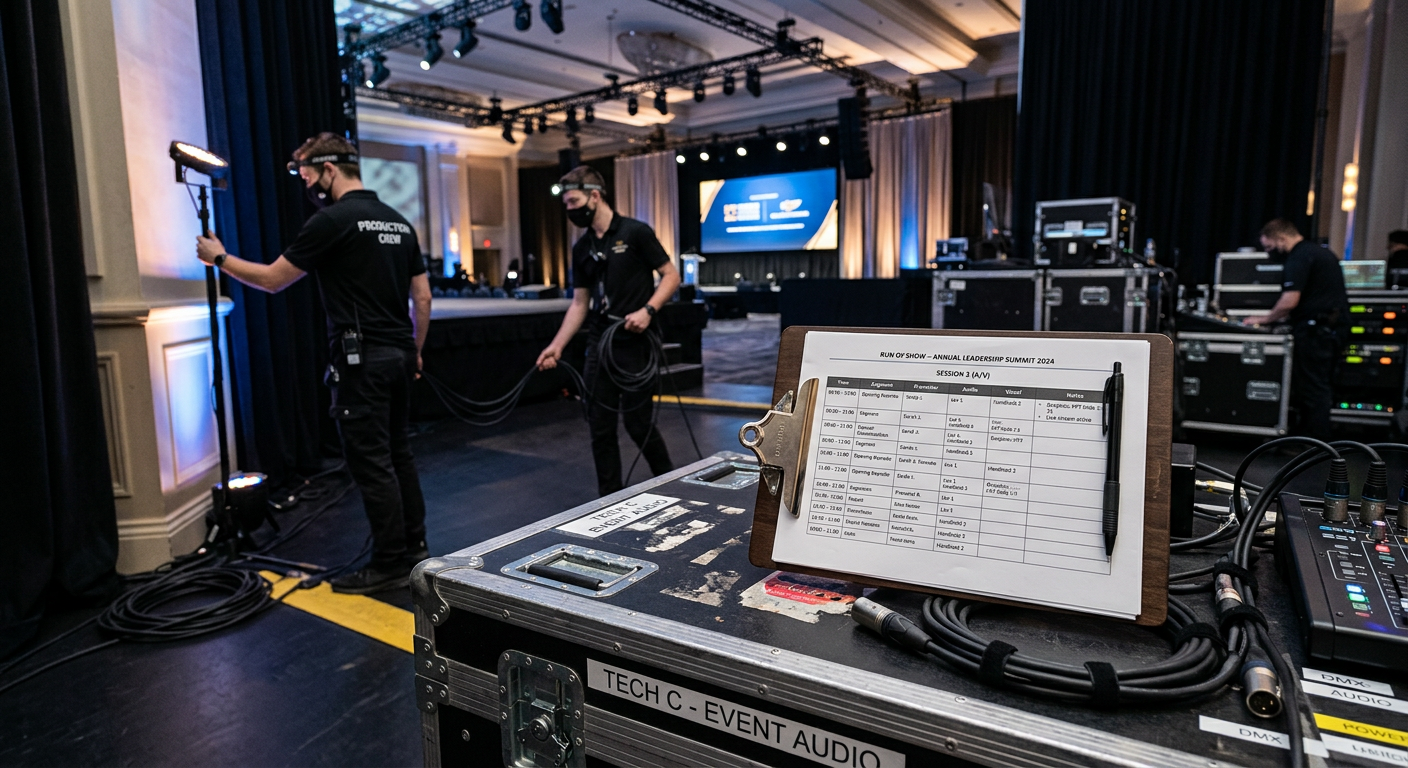
The most frequent cause of a delayed event is not a single late supplier, but a misunderstood dependency chain during the load-in phase. Event schedules are entirely sequential. A lighting supplier cannot rig their trusses if the staging company has not finished levelling the platform. The staging company cannot build if the room dressers are laying temporary flooring. If the flooring team arrives twenty minutes late, that delay cascades through every subsequent supplier, compounding at each step because successive teams are left waiting in loading bays rather than working.
To prevent this, practitioners map the critical path of the event build. This involves separating suppliers into distinct access tiers based on physical interference. Heavy infrastructure, such as staging, trussing, and temporary power distribution, must occupy the first tier. Only when that tier signs off on their physical footprint can the secondary tier, which includes catering setup, tables, and decorative elements, begin their work. Attempting to overlap these tiers to save time invariably causes physical bottlenecks at venue access points, slowing both teams down and increasing the risk of equipment damage. Understanding how to build these schedules requires consulting A Complete Guide to Professional Event Hire for Seamless Occasions in 2026 to properly categorise supplier requirements.
Practical rule: Never schedule two suppliers to use the same physical access route or loading bay simultaneously. Always stagger arrival times by a minimum of thirty minutes per heavy vehicle.
Furthermore, the run of show requires the same sequential discipline as the load-in. Buffer times are not empty spaces in a schedule; they are the shock absorbers for real-world friction. Moving two hundred people from a drinks reception to a dining room does not happen instantly. It requires specific announcements, physical corralling, and time for guests to find their seats. Failing to budget fifteen to twenty minutes solely for guest movement means the entire evening schedule starts at a deficit.
Where infrastructure limits dictate your guest capacity
Before confirming any supplier contracts, an event coordinator must audit the physical realities of the venue. The most restrictive invisible limit is electrical power. A standard UK 13-amp socket on a ring main can only support a specific electrical load before tripping the circuit breaker. When a caterer plugs in a commercial hot cupboard, an audio engineer connects a PA system, and an entertainment provider powers up high-draw lighting on the same circuit, the total kilovolt-ampere requirement often exceeds the venue’s domestic infrastructure.
This is particularly relevant for temporary structures like marquees or heritage venues in rural locations such as the Scottish Highlands, where power drops are common. Calculating the combined draw of every required element dictates whether you can rely on venue mains or if you must hire external generators. If external power is required, the layout of the event must change to accommodate heavy cabling, cable ramps for pedestrian safety, and acoustic baffling to isolate generator noise from the guest experience. When evaluating 7 Professional Photo Booth Rental Services for Your 2026 Event, you must calculate not just the cost, but the specific power draw and floor space the interactive setup demands from your total capacity.
Space constraints apply beyond the dance floor. Every supplier requires a working footprint that is larger than their performance footprint. A caterer needs a prep area; a band needs a green room and secure storage for empty flight cases; entertainment add-ons like a selfie pod require queueing space so guests do not block fire exits. Failing to map these operational zones onto the floor plan results in a cluttered, unsafe environment that actively works against the flow of the gathering. For strategies on securing suppliers who provide accurate footprint data, reviewing How to Source Reliable Professional Event Hire in 2026 clarifies the right questions to ask during procurement.
How venue regulations actively shape production options
Venues do not merely host events; they impose strict regulatory frameworks that dictate exactly what can occur within their walls. In the UK, environmental health regulations regarding noise pollution mean that many venues, particularly heritage sites or hotels in residential areas, operate with mandatory sound limiters. These devices measure the decibel level in the room. If the volume exceeds a predetermined threshold (often between 85dB and 95dB) for a sustained period, the limiter automatically cuts electrical power to the performance area.
This single regulation forces entirely different production choices. If a venue has a strict 85dB limiter, booking a ten-piece live band with an unamplified brass section and acoustic drum kit is a severe operational risk, as the physical instruments alone will trip the system before any vocals are amplified. In these cases, opting for alternative entertainment formats where the total volume output can be digitally throttled at a master mixing desk becomes a necessity, not just a preference. You must design the entertainment around the venue’s restrictions, rather than attempting to force a rigid format into an incompatible space.
Similarly, atmospheric effects are heavily regulated. The use of smoke machines, hazers, or indoor pyrotechnics requires isolating specific fire alarm zones to prevent false evacuations. Many venues simply blanket-ban these elements to avoid the risk entirely. You must obtain written permission from the venue’s duty manager outlining exactly which atmospheric effects are permitted before writing them into a production schedule. Proceeding on assumption invariably leads to the venue halting the performance on the night.
Comparing logistical approaches for large gatherings
When scaling an event beyond fifty people, the administrative burden of coordinating multiple suppliers increases exponentially. Planners generally adopt one of two structural approaches to manage this workload, each carrying distinct operational trade-offs.
| Coordination Model | Core Mechanism | Primary Vulnerability | Best Suited For |
|---|---|---|---|
| Decentralised (Siloed) | The client contracts and communicates with each supplier individually. Suppliers manage their own timelines. | Conflicting assumptions. The caterer and the AV team may plan to use the same loading bay at the same time. | Smaller, single-room gatherings with minimal technical requirements. |
| Centralised (Managed) | A designated event manager acts as the single point of contact, issuing a unified run of show to all parties. | Requires relinquishing direct control. High dependency on the competence of the central manager. | Large-scale corporate functions, complex weddings, and multi-day events. |
Decentralised management fails at scale because it lacks a unified perspective. A supplier only knows what is contained within their specific brief. If an evening entertainer requires access to the room at 18:00 for a soundcheck, but the venue staff are still clearing the dining tables from the afternoon session, the resulting clash delays the entire evening schedule.
Centralised management prevents this by demanding a unified master schedule. The event manager cross-references every supplier contract to identify logistical overlaps, ensuring that the room is actually ready before the next team attempts to load in.
Practical rule: Never allow suppliers to negotiate timelines directly with the venue on your behalf. All communication regarding access times must pass through one central event manager to prevent double-booking the space.
Why transitions expose poor production planning
The true test of an event’s architecture is not what happens during the main segments, but what happens between them. Transitions are the most vulnerable parts of any gathering. The shift from a formal corporate plenary session to an evening networking mixer, or from a wedding breakfast to an evening reception, requires rapid environmental changes.
If these transitions are not deliberately engineered, they result in ‘dead air’ – periods where guests are left standing in poorly lit corridors while staff hurriedly drag furniture across a room. This instantly destroys the atmosphere and breaks the momentum of the gathering. Managing these shifts requires micro-scheduling. While the venue staff are turning the room, the guests must be intentionally directed to a holding area equipped with its own distinct atmosphere, lighting, and background audio to mask the sounds of heavy furniture moving next door. Exploring How to Curate the Perfect Playlist for a Professional DJ for Corporate Events in 2026 demonstrates how audio cues are used to subtly herd guests between spaces without relying on harsh public address announcements.
Furthermore, external talent arriving for the evening segment must be managed invisibly. If evening entertainment providers arrive during the afternoon speeches, they cannot simply wheel heavy flight cases through the main thoroughfare. Their load-in route must be mapped through back-of-house corridors, and their setup must be silent. When evaluating options like 4 Top Providers of a DJ for Corporate Events in 2026: Agency vs Platform, the ability of the provider to execute a discreet, self-contained load-in is just as critical as their performance capability.
What documentation proves a site is actually ready
Professional event management requires treating the venue as a temporary workplace, which means adhering strictly to health and safety compliance. A gathering cannot proceed safely on trust; it requires verifiable documentation. Before any heavy equipment crosses the threshold, specific paperwork must be exchanged between the suppliers, the event manager, and the venue’s operations team.
The most critical document is the Risk Assessment and Method Statement (RAMS). This outlines exactly how a supplier intends to build their equipment, identifying potential hazards such as trailing cables, heavy lifting, or working at height, and the steps they will take to mitigate them. Reputable venues will deny entry to suppliers who cannot produce a site-specific risk assessment.
Equally important is Public Liability Insurance (PLI). While a standard policy might cover £1 million or £2 million, premium UK venues and local authority spaces often mandate a minimum of £10 million in PLI coverage for all external contractors. If a supplier arrives on site with inadequate insurance, the venue reserves the right to cancel their involvement immediately to protect their own liability.
Finally, Portable Appliance Testing (PAT) certification is non-negotiable. Every piece of electrical equipment brought into the venue – from a simple extension lead to an entire lighting rig – must carry an up-to-date PAT sticker verifying it has been independently tested for electrical safety. Venues routinely inspect these stickers during the load-in phase. Equipment lacking a valid certificate will be removed from the power grid, potentially leaving you without vital audio or lighting infrastructure moments before the guests arrive. Gathering this documentation weeks in advance is the only way to ensure the site is legally ready to operate.
FAQ
How much buffer time should a run of show include?
At a minimum, inject fifteen minutes of buffer time for every transition that requires moving more than fifty guests. For complex room turnarounds involving furniture changes, allocate at least forty-five minutes to an hour to prevent subsequent schedule delays.
What is a sound limiter and how does it affect event management?
A sound limiter is an environmental health device installed by venues to monitor decibel levels. If the volume exceeds a set limit (usually 85dB to 95dB) for a sustained period, the limiter cuts power to the room. It forces you to select entertainment formats that can tightly control their audio output.
Who is legally responsible for supplier health and safety compliance?
While suppliers are responsible for their own safe working practices, the overarching responsibility for the event’s safety lies with the organiser or designated event manager. You must collect and verify all RAMS, PLI, and PAT certificates before authorising a supplier to begin work.
When should supplier load-in times be finalised?
Load-in schedules must be locked at least fourteen days prior to the event. This provides enough time to identify overlapping access requests, negotiate staggered arrival times, and submit the final master schedule to the venue for approval.
How does venue power capacity restrict entertainment choices?
Many historic or rural venues operate on standard domestic ring mains which cannot support heavy industrial loads. If your combined technical requirements exceed the venue’s kilovolt-ampere limit, you must hire external generators, which subsequently alters the site layout and budget.