The moment the venue coordinator hands over the mandatory supplier questionnaire thirty days before the event, the reality of booking entertainment sets in. Suddenly, questions about three-phase power requirements, valid Public Liability Insurance certificates, and footprint dimensions replace conversations about playlists. Finding the right wedding DJ London venues actually approve of requires navigating these operational constraints before a single track is selected. The capital’s historic buildings enforce strict acoustic limits, while purpose-built spaces demand heavy technical infrastructure.
Quick Summary
Evaluating entertainment for a London reception requires balancing technical payloads against venue restrictions. This guide examines five professional setups, detailing how different commercial models distribute the risk of sound deployment and timeline management.
- Discologic leverages a high-referral network for reliable venue integration.
- Wedding Smashers consolidates sound and lighting into fixed technical packages.
- Mighty Fine Events scales from basic setups to full room production.
- SpinSisters separates hardware from hourly performance rates.
- We R DJs provides full-day continuity to eliminate changeover silence.
Table of Contents
- Buying Guide: How to Choose
- 1. Discologic
- 2. Wedding Smashers
- 3. Mighty Fine Events
- 4. SpinSisters
- 5. We R DJs
- Mapping Operational Models to Your Event
- Recommended Reads
| Product | Operational Model | Features | Pros | Cons | Target Audience |
|---|---|---|---|---|---|
| Discologic | Specialist Agency | Kent/London coverage, high referral rate | Established venue trust, competitive entry price, proven reliability | Strict regional limits, low short-notice availability, rigid scheduling | Couples prioritising proven regional reliability. |
| Wedding Smashers | Independent Collective | The Smash Pack, roster management | Unified footprint, guaranteed backup, clear aesthetic | Heavy initial deposit, rigid aesthetic focus, upfront capital required | Buyers needing a unified technical footprint. |
| Mighty Fine Events | Volume Production Company | Broad regional coverage, extensive reviews | End-to-end production, scalable logistics, wide deployment | Vast pricing variance, baseline restrictions, aggressive upgrade path | Events requiring massive technical infrastructure. |
| SpinSisters | Independent Collective | Modular hardware pricing, female roster | Hardware flexibility, granular billing, tailored sound payloads | High weekend minimums, severe overrun risks, complex billing | Buyers with strict schedules and precise hardware needs. |
| We R DJs | Specialist Agency | 10-hour continuous coverage, hardware-free options | Timeline continuity, single point of contact, seamless transitions | Client must manage welfare, venue hardware liability, endurance limits | Celebrations requiring seamless all-day audio coverage. |
Buying Guide: How to Choose
Comparing entertainment options strictly by their promotional mixboards ignores the actual mechanism of event delivery. The true differentiator is the underlying commercial structure governing how hardware is deployed and how liability is managed when schedules slip.
We classify these services along a primary axis: their Operational Model.
- Specialist Agency: These setups focus on specific regional footprints or distinct service packages, acting as a highly tuned conduit between the venue and the performer. They typically rely heavily on local venue referrals and fixed-duration packages.
- Independent Collective: A centrally managed roster of performers sharing branding and technical standards. This model absorbs the risk of individual performer cancellation by deploying cross-briefed replacements, often modularising their hardware to fit varying venue limits.
- Volume Production Company: Large-scale entities that manage the entire technical infrastructure of an event. They own vast inventories of lighting, rigging, and audio equipment, treating the musical performance as just one component of a wider logistical deployment.
Selecting the correct model requires assessing your venue’s existing infrastructure. A fully equipped nightclub space requires a completely different operational approach than a historic barn lacking primary power sockets.
1. Discologic
Does a venue’s preferred supplier list guarantee a smoother reception? Operating as a Specialist Agency, they provide entertainment across Kent and the capital, focusing on securing trust through established venue networks rather than broad digital acquisition. On Hitched, 218 reviewers give this operation a 5.0 out of 5 rating, with packages starting from £645.
Their mechanism relies heavily on a closed feedback loop with event coordinators. Most wedding clients book their services through recommendations. This structural reliance on word of mouth forces them to maintain flawless compliance with venue regulations, from up-to-date electrical testing to adhering strictly to installed noise limiters. I would hold off if the musical brief radically departed from standard wedding formats, as high-volume referral networks often standardise their sets to protect their venue relationships.
High referral rates demand early engagement
Winning the Kent wedding DJ of the year award in 2012 and 2013 established a long-standing regional dominance, meaning their calendar fills strictly through industry recommendations. For couples with short lead times under six months, finding availability is highly unlikely, forcing a pivot to less established operators.
Couples prioritising a proven track record without entering the premium price bracket will find this suitable.
Pros
* Pre-approved by many local venues
* Accessible starting price point
* Strong regional track record
Cons
* Availability vanishes quickly
* Aesthetic may lean traditional
* Limited to specific geographic radius
2. Wedding Smashers
Audio distribution at a reception relies on matching the amplifier output to the room’s acoustic profile. Established in 2010, this Independent Collective operates as an agency curating specific aesthetic profiles and packaging their technical delivery into fixed units.
Rather than piecing together disparate rental gear based on venue whims, they offer an equipment package named The Smash Pack, which contains a sound and light setup designed to operate cohesively. Hiring services start at £990 on Bridebook. The collective mechanism means they manage the backup roster internally; if a performer falls ill, the central agency deploys a pre-briefed replacement without the couple having to source one independently. This isolates the buyer from the single point of failure that plagues solo operators. Before committing, reviewing the essential factors to consider for wedding DJ hire helps contextualise how much risk a collective absorbs on your behalf.
Upfront commitment secures the collective’s roster
Securing bookings requires a reservation fee deposit of one-third of the total cost. This initial cash outlay is unusually steep compared to standard flat booking fees, heavily impacting couples who are simultaneously paying catering and venue deposits in the same month.
Securing this act makes sense when the entertainment budget is front-loaded and a unified technical footprint is required.
Pros
* Guaranteed performer redundancy
* Predictable technical footprint
* Curated roster standards
Cons
* Heavy initial cash requirement
* Rigid package structures
* Higher baseline entry cost
3. Mighty Fine Events
Unlike collectives that focus exclusively on DJ curation, this entity functions as a comprehensive event production machine. Serving weddings and events across London, the South East, and the Midlands, this Volume Production Company handles the entire technical infrastructure alongside the music.
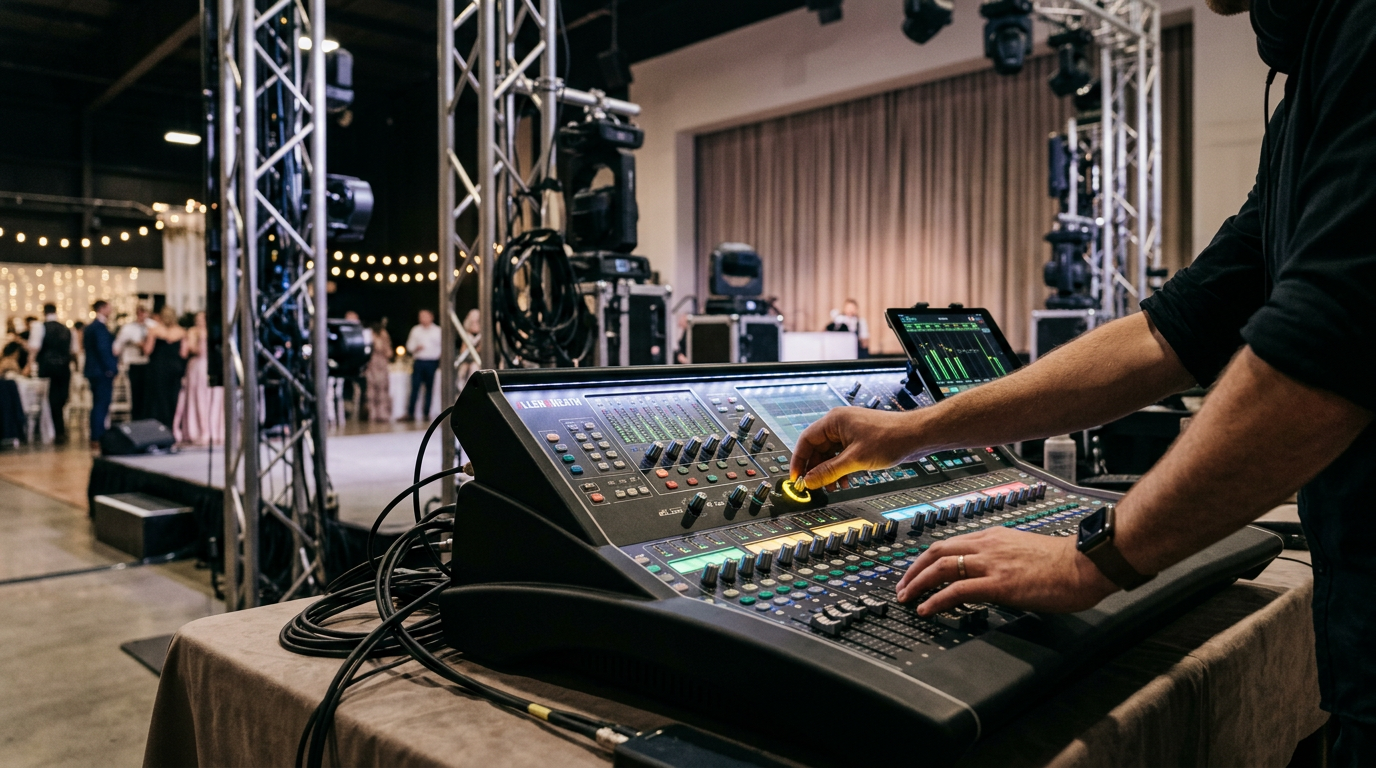
Their mechanism treats the reception as a logistics exercise. They do not just plug into a venue’s wall; they calculate load-ins, manage discrete PAs for ceremony audio, and coordinate intelligent lighting across massive spaces. This setup suits dry-hire venues where every piece of infrastructure must be imported and managed by a dedicated team. On their website and Guides for Brides, they pair 501 reviews with typical wedding DJ service prices ranging from £750 to £3,000, highlighting their capacity to execute at scale.
Practical rule: Never assume a dry-hire venue’s power supply can handle a full production load; always request the technical specifications before contracting a high-volume production team.
Breadth of service introduces pricing elasticity
The vast gap between their entry-level and premium tiers strongly suggests the starting point provides a highly restricted baseline service. Buyers expecting the expansive production value featured in the company’s promotional material will quickly find themselves pushed toward the upper end of their budget to achieve the desired result.
Those requiring end-to-end production logistics across large, unequipped spaces should evaluate their mid-tier and premium packages.
Pros
* Massive technical capacity
* Extensive regional reach
* Dedicated logistics handling
Cons
* Entry tier lacks full production
* Aggressive upgrade pathways
* Overkill for equipped venues
4. SpinSisters
Does the venue possess an adequate installed sound system, or must the entertainment supply its own subwoofers? This professional female DJ collective provides entertainment for weddings, private parties, and corporate events by separating the performance fee from the hardware hire.
As an Independent Collective, they adapt. Their mechanism lets buyers strictly tailor the technical payload to the room. Hourly DJ rates range from £150 to £600, while a full sound package costs £550. A larger equipment package adds a DJ booth, speakers, lights, microphones, and a subwoofer. This modular approach helps. It stops couples paying for a heavy bass rig in venues with strict noise limiters. Understanding the variables determining your professional wedding DJ cost clarifies why splitting hardware from human hours creates commercial flexibility.
Granular pricing requires strict timeline management
Most DJs in the collective require a minimum call-out fee for Saturday nights, rendering their lower hourly rates irrelevant for peak weekend events. Couples miscalculating their timeline will face severe cost overruns when billed by the hour during an inevitably delayed evening reception.
Buyers with highly regimented schedules and precise hardware requirements benefit heavily from this modular billing structure.
Pros
* Hardware matches venue limits
* Transparent hourly billing
* Distinct female-led roster
Cons
* Schedule slips compound costs
* High Saturday minimums
* Complex initial quoting
5. We R DJs
Transitioning from afternoon background playlists to a live evening reception often creates a disruptive silence as suppliers change over. This London-based mobile DJ company removes that operational gap by embedding themselves into the entire event timeline.
They operate from 71-75 Shelton Street in Covent Garden. This Specialist Agency deploys packages that lock down the day’s audio requirements. Their Full Day DJ Package offers up to 10 hours of continuous or flexible coverage starting from £1,200. A Half Day DJ Package provides up to 5 hours of music and entertainment services. They also offer a DJ Only Package. This suits events where sound and lighting equipment are already provided. Buyers must approach this hardware-free option with caution. It demands a dedicated, club-grade PA system. Standard hotel ceiling speakers instantly distort under reception volume limits.
Practical rule: Hardware-free packages shift the liability for audio failure entirely onto the venue’s maintenance schedule; test the installed system at full volume before signing.
Hardware exclusion packages shift liability to the venue
Committing to a ten-hour continuous deployment means the operator requires strict welfare provisions, including scheduled breaks and supplier meals, which the client must orchestrate into an already dense timeline. Neglecting this logistics burden leads to performance fatigue long before the headline set begins.
Allocating a single supplier for ten hours of continuous music is the pragmatic choice for single-venue celebrations requiring seamless audio transitions.
Pros
* Eliminates awkward changeovers
* Predictable full-day cost
* Hardware-free option available
Cons
* Heavy welfare demands on client
* Requires careful break scheduling
* Venue hardware risks failure
Mapping Operational Models to Your Event
Choosing the correct entertainment architecture dictates how smoothly your reception flows and who absorbs the technical risks on the day.
Opting for a Specialist Agency is the logical move for couples heavily reliant on a single venue’s ecosystem. When operators spend years building referral networks in specific regions, they inherently understand the acoustic quirks, load-in bottlenecks, and management preferences of those buildings. When evaluating wedding DJs operating in Essex and Kent, or central London, booking an agency that already holds the venue’s trust bypasses weeks of administrative friction over insurance and method statements.
Deploying an Independent Collective protects the timeline against individual failure. The primary hazard of booking solo operators is the lack of redundancy; a collective absorbs that risk centrally. Their modular billing structures allow you to scale the hardware exactly to the room size, preventing you from paying for arena-level subwoofers in a space with a 90-decibel noise limiter.
Engaging a Volume Production Company becomes mandatory when the venue provides nothing but walls and a roof. Dry-hire spaces demand complex logistics, from rigging intelligent lighting to distributing power across multiple phases. This model shifts the burden of technical integration entirely onto the supplier, ensuring the musical performance is supported by an infrastructure designed specifically for that space.