
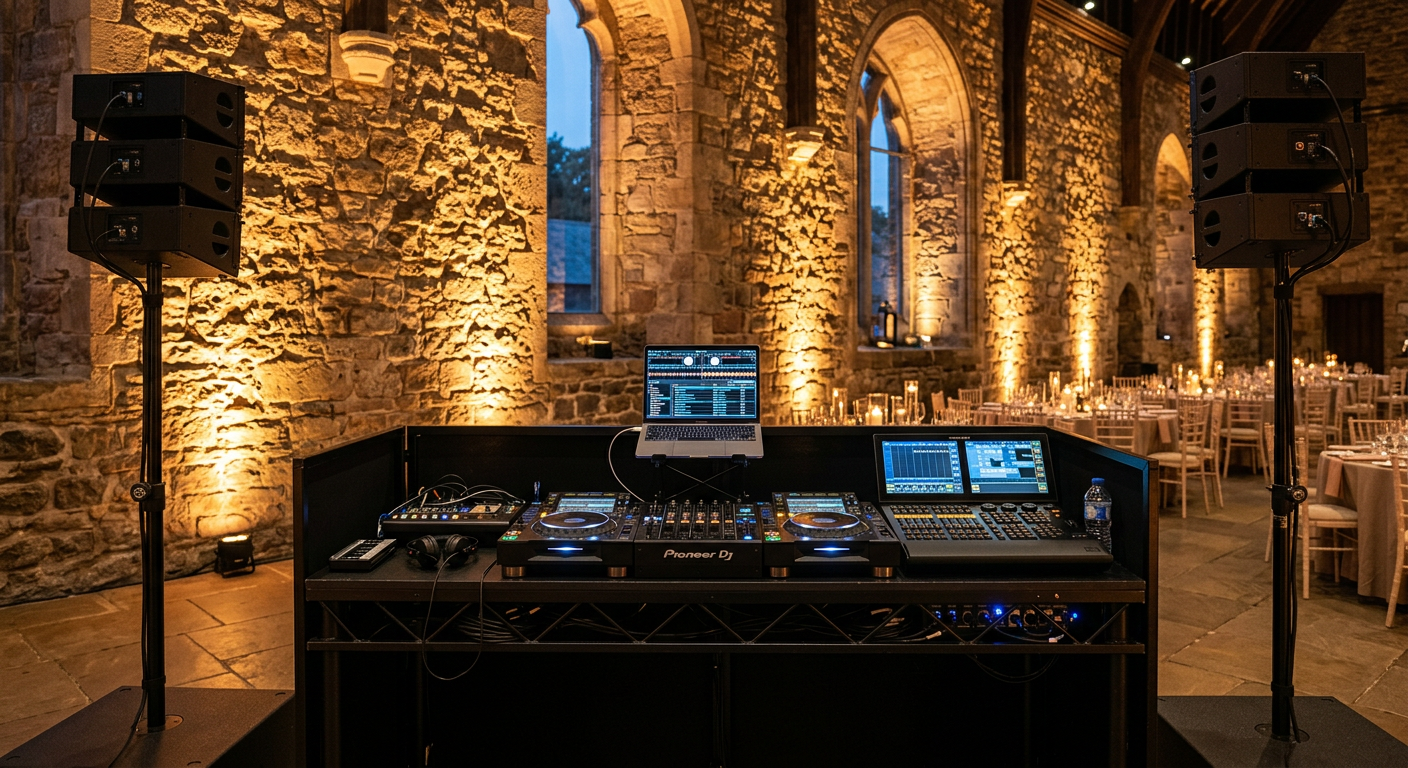
An event coordinator stands in a listed Highland castle at 5:00 PM on a Saturday. The mobile disco provider has just unloaded their rig, only to discover the venue’s restrictive power policy strictly forbids their 16-amp lighting desk without an external generator. The supplier vanishes to find cables, the guests are arriving in an hour, and the room sits in silence. This scenario plays out constantly because securing reliable event hire is treated as a simple transaction rather than a logistical integration. Booking a professional is not just about listening to an audio demo or looking at a photo booth catalogue; it is about verifying the mechanical and administrative infrastructure that stops a party from failing before it begins.
Quick Summary
Professional event hire involves procuring technical equipment and operators under a structured agreement that guarantees compliance, logistical feasibility, and technical redundancy. Sourcing these services requires moving beyond aesthetic choices to audit a supplier’s operational resilience.
- Define technical requirements before browsing supplier inventories to prevent venue incompatibilities.
- Demand verifiable safety paperwork, as venues routinely reject uncertified equipment at the door.
- Reject hourly billing for full events; per-event pricing prevents rushed breakdowns and hidden late fees.
- Audit the supplier’s active redundancy plan to ensure equipment failures do not cause dead air.
Table of Contents
- 1. Why Standard Event Hire Inventory Lists Fail to Define Scope
- 2. Why Venue Managers Reject Unverified Paperwork
- 3. Where Hourly Pricing Creates Logistical Friction
- 4. How Single Points of Failure Collapse an Event
- 5. What Unrealistic Load-in Windows Cost You
- Common Pitfalls and Troubleshooting
- FAQ
- Recommended Reads
1. Why Standard Event Hire Inventory Lists Fail to Define Scope
The fundamental error in securing entertainment and production is starting with the supplier’s catalogue instead of the venue’s physical and technical constraints. Practitioners categorise services into two streams: dry hire, where equipment is delivered for you to operate, and wet hire, where the equipment comes with a professional operator or host. Treating a wet hire service like a simple delivery of goods leads directly to spatial and logistical clashes.
Before approaching a supplier, you must map the operational footprint. A comprehensive sound and lighting rig requires specific dimensions – often a minimum of three by two metres of clear floor space, unrestricted sightlines, and proximity to dedicated 13-amp or 16-amp power circuits. Adding peripheral entertainment complicates this further. A compact, open-air photo pod requires less space than an enclosed booth, but still demands an area free from heavy foot traffic to prevent trip hazards around its power supply.
The mistake people make here is booking by aesthetic preference without conducting a site survey. An event planner secures a massive, bass-heavy PA system for a historic venue with strict acoustic limits and fragile architecture, resulting in the venue manager forcing the supplier to run the system at a whisper. Couples planning full-day celebrations often compare standard dry-hire options against comprehensive Weddings – JP the DJ packages to understand the difference in logistical support, realising that a professional host manages the room’s acoustic dynamics rather than just providing the speakers.
2. Why Venue Managers Reject Unverified Paperwork
Technical excellence means nothing if the supplier is legally barred from plugging their equipment into the wall. In the UK, professional venues operate under strict insurance and health and safety mandates. They require external suppliers to provide two non-negotiable documents: a valid Portable Appliance Testing (PAT) certificate and proof of Public Liability Insurance (PLI).
PAT testing is an annual electrical safety check required under the IET Code of Practice. It confirms that amplifiers, lighting rigs, and extension leads are properly earthed and insulated, preventing electrical fires or fatal shocks. PLI protects the client and venue in the event that a supplier’s equipment causes injury or property damage. A standard professional policy covers up to £10 million, which is the baseline requirement for most council-owned buildings, historic properties, and premium hotels in regions like Aberdeenshire and Moray.
The critical failure here is accepting a supplier’s verbal assurance that they are “fully insured”. A venue manager does not care about promises; they require the PDF certificates filed before the event date. If a supplier arrives on site with expired PAT stickers on their flight cases, the venue’s duty manager has the authority to refuse them access to the mains power. Always demand digital copies of both certificates during the initial contracting phase. If a supplier hesitates or claims the venue will not check, they are a liability you cannot afford to book.
3. Where Hourly Pricing Creates Logistical Friction
Pricing structures dictate supplier behaviour. The entertainment sector generally splits into two billing models: hourly rates and per-event fees. For full-scale events like weddings or corporate galas, hourly pricing is a deeply flawed model that misaligns the incentives of the client and the supplier.
When a supplier charges by the hour, the logistics of travel, load-in, and breakdown become points of financial friction. This is especially true in remote areas like the Scottish Highlands, where navigating single-track roads and winter weather adds unpredictable hours to a journey. An hourly supplier either charges a punitive travel rate, rushes the complex assembly of lighting and audio gear, or presents a surprise invoice when an event naturally overruns by twenty minutes.
Practical rule: Always demand a line-item breakdown of turnaround times – load-in, assembly, operation, and strike – before accepting any fee, and ensure the final contract states a fixed per-event cost.
Per-event pricing, conversely, transfers the logistical risk to the professional. The fee covers the entirety of the project from the moment they leave their depot to the moment they return. This model guarantees transparency and allows the supplier to take the necessary time to safely construct heavy lighting totems and calibrate sound systems without watching the clock. Do not book suppliers who refuse to offer a fixed, per-event quotation for full-day functions; their flexibility usually ends the moment their scheduled hours expire.
4. How Single Points of Failure Collapse an Event
Every piece of electronic equipment eventually fails. The mark of a professional operation is not that their gear never breaks, but that the audience never notices when it does. This requires active redundancy – a deliberate engineering strategy where secondary systems take over immediately if a primary component faults.
Mechanically, this looks like signal duplication and independent power routing. In a professional audio setup, a DJ or host will use active speakers, each containing its own internal amplifier. If one speaker suffers a blown fuse, the remaining speakers continue to carry the room. If a primary mixing desk freezes or a laptop hard drive crashes, the operator should have a secondary, independent playback device hardwired into an analogue channel, ready to push live with a single fader movement.
The mistake amateur buyers make is believing that “having a backup in the van” constitutes redundancy. If a crucial amplifier dies in the middle of a packed dance floor, a backup in a vehicle parked half a mile away in the venue’s loading bay means twenty minutes of dead air and a ruined atmosphere. When auditing a supplier, ask explicitly how they handle a primary playback failure. If their answer involves fetching cables from their transport, their redundancy plan is inadequate for a live environment.
5. What Unrealistic Load-in Windows Cost You
The most chaotic period of any event is the “turnaround” – the brief window when daytime activities conclude and evening production begins. Venue staff are clearing tables and resetting the room, while external suppliers are attempting to safely wheel hundreds of kilograms of equipment through the same doors.
Professional setup requires a defined critical path. A supplier must secure their power feed, erect structural supports, run heavy-duty cabling, and tape down all trip hazards before any guests enter the room. This process is governed by the venue’s architecture. A modern hotel might offer a flat, ground-level loading bay, allowing a full rig to be assembled in forty-five minutes. A historic venue with narrow staircases, noise limiters, and strict rules against rolling flight cases across antique wooden floors might require two hours for the exact same setup.
The failure mode here is the client dictating the load-in time based on their event schedule rather than the physical reality of the site. Telling a supplier they have thirty minutes to construct a mobile disco and a photo booth because the speeches ran late compromises safety. Adding peripheral elements to a tight load-in window requires careful planning; reviewing an overview of Events & Additional Services – JP the DJ demonstrates how modular add-ons like room uplighting or custom projections scale the required setup time. Always connect the supplier directly with the venue’s operations manager weeks in advance to agree on a realistic, safe turnaround schedule.
Common Pitfalls and Troubleshooting
Even with rigorous vetting, the friction of live events creates specific, recurring failures. Diagnosing these from the outside ensures you apply the correct logistical fix rather than blaming the wrong component.
The Silent Supplier
This is the most common failure in the industry.
– Symptom: You send an urgent query about changing the floor plan three weeks before the event, and the supplier does not reply for seven days.
– Fix: Do not assume they have gone out of business, but do not tolerate the silence. The fix must happen at the contracting stage: establish a primary contact method (such as a dedicated WhatsApp channel or direct phone line) and a mandated Service Level Agreement (SLA) for replies. If a supplier fails their SLA in the planning phase, escalate to a phone call to demand written confirmation of your changes.
The Incompatible Audio Feed
– Symptom: During speeches or background music, a loud hum, buzz, or crackle overwhelms the PA system, particularly when a laptop or phone is plugged in.
– Fix: This is rarely a blown speaker; it is usually a ground loop issue caused by connecting consumer electronics to a professional PA system on a different power circuit. The immediate fix is to unplug the device from the mains and run it on battery power. The professional fix, which your supplier should provide, is running the audio through a Ground Loop Isolator or a DI (Direct Injection) box to balance the signal and eliminate the hum.
The Saturated Power Circuit
– Symptom: Ten minutes into the evening reception, all the venue’s wall sockets trip, plunging the room into darkness while the main venue lights stay on.
– Fix: The supplier has drawn too much current from a single ring main. A high-output PA system, a smoke machine, and twenty uplighters can easily exceed the 13-amp limit of a standard UK socket. The immediate fix is for the venue to reset the breaker. The preventative fix is demanding the supplier calculates their total electrical draw in advance and distributes their power cables across separate, independent circuits in the room.
FAQ
Why do venues demand £10m Public Liability Insurance?
While smaller private events might theoretically require less coverage, £10 million has become the industry standard for local authority buildings, luxury hotels, and historic properties. It ensures that in the event of catastrophic property damage – such as a lighting rig collapsing and triggering a sprinkler system in a listed building – the policy is robust enough to cover extensive restoration and commercial losses.
What does a per-event pricing basis actually cover?
Unlike hourly billing, a per-event basis covers the total logistical scope of the service. This typically includes the pre-event consultation, travel costs, vehicle loading, the physical setup and breakdown time, and the active performance hours. It provides a fixed ceiling for your budget, ensuring no hidden penalties if the load-out takes longer than anticipated.
How do noise limiters affect live event equipment?
Many venues install environmental noise limiters to comply with local council regulations. These devices cut the main power to the room’s plug sockets if the decibel level exceeds a set threshold for more than a few seconds. If triggered, the sound equipment powers down abruptly, which can damage amplifiers and ruin the atmosphere. Professional suppliers must be informed of limiters in advance so they can manage their acoustic output and equalisation to avoid triggering the system.
How far in advance should production and entertainment be booked?
For prime weekend dates in the summer or during the December corporate season, reliable professionals are often secured eighteen to twenty-four months in advance. Booking late severely limits your options, often leaving only inexperienced operators or those without the necessary compliance paperwork to legally operate in your chosen venue.