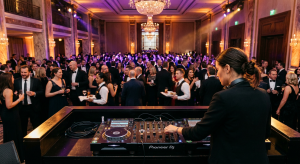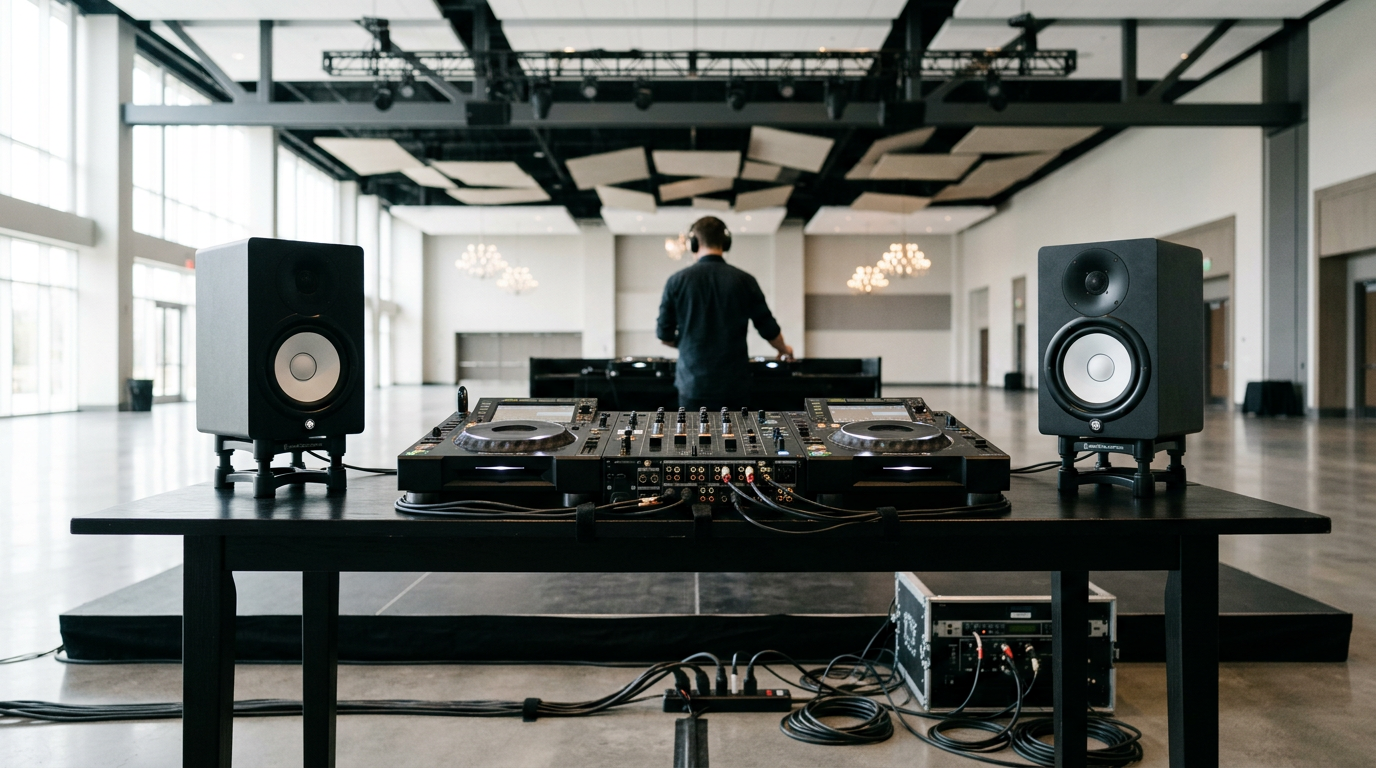
A frequent misconception in event planning is treating acoustic curation as a purely digital problem. Planners often assume that delivering audio to a room of 500 delegates requires nothing more than a laptop connected to the venue’s installed ceiling speakers. In reality, those systems are wired for spoken-word clarity, lacking the low-frequency response and dispersion necessary to drive a lively networking hour or an evening gala. Procuring a dj for corporate events requires evaluating structural logistics alongside musical talent. You are hiring a temporary, high-voltage technical installation that must seamlessly bridge the transition from ambient background audio to main-stage energy, all while navigating rigid load-in windows and complex power distribution.
Quick Summary
Sourcing professional audio for a business function involves balancing hardware provision against pure talent matching. The market divides into distinct operational frameworks that dictate who holds the liability for equipment failure and acoustic coverage.
- Curated Collectives standardise the production baseline but charge heavily for prime-time availability.
- Open Marketplaces remove administrative margins but shift technical due diligence entirely onto the client.
- Hybrid Entertainment Agencies deliver high visual impact but demand significantly larger physical staging areas.
- Separate talent rates from hardware costs early, as scalable public address (PA) configurations dictate the final event invoice.
Table of Contents
- Comparing Corporate Event DJ Providers
- Operating Models Dictate Technical Liability
- 1. SpinSisters
- Transparent scaling dictates the final invoice
- 2. DJ Agency
- Direct matching removes the administrative premium
- 3. JW DJ Agency
- Roster development prioritises long-term placements
- 4. Your DJ & More
- Live integration demands a higher baseline footprint
- Aligning Your Corporate Profile with the Provider
- Recommended Reads
Comparing Corporate Event DJ Providers
| Provider | Operating Model | Features | Pros | Cons | Target Audience |
|---|---|---|---|---|---|
| SpinSisters | Curated Collective | All-female roster, tiered production packages | Transparent equipment scaling, UK-wide reach, defined tier boundaries | Roadie surcharges in cities, separate hardware costs, high Saturday minimums | Premium brand launches |
| DJ Agency | Open Marketplace | Zero client fees, platform matching | No intermediary markup, broad hourly rate span, flexible set pricing | Client retains vetting burden, inconsistent hardware provision, detached after booking | Budget-conscious event planners |
| JW DJ Agency | Curated Collective | Environmental offset, residency focus | Verifiable sustainability policy, 24-hour continuous support, live vetted talent | Geared toward club residencies, opaque baseline rates, less focus on ad-hoc dry hire | Long-term venue contracts |
| Your DJ & More | Hybrid Entertainment Agency | DJ and live instruments, custom builds | Integrated live elements, high review ratings, bespoke configurations | Extensive stage requirements, complex audio monitoring, strict logistical demands | High-impact awards galas |
Operating Models Dictate Technical Liability
Before assessing individual rosters or comparing playlists, you must establish the operational framework that suits your logistical constraints. The service delivery model determines whether you are buying a fully self-contained production unit or simply paying for a musician to arrive with a USB stick. The Mechanics of Professional Event Management for Large Gatherings in 2026 often hinge on how well these technical boundaries are defined during the initial procurement phase.
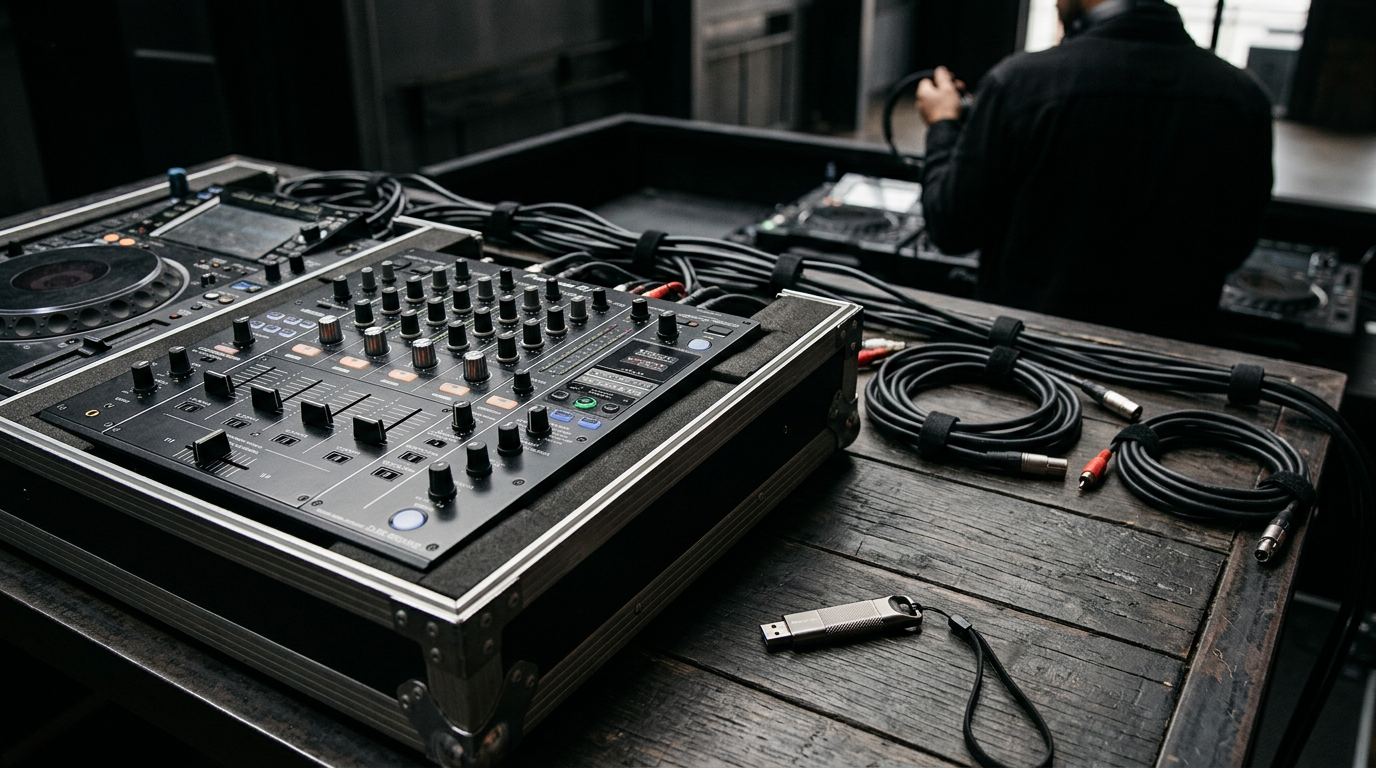
We categorise the market using the Operating Model axis, divided into three distinct approaches:
Curated Collective: These organisations maintain a strict internal roster, standardising the quality of both the performer and the equipment they deploy. By separating the talent fee from the hardware cost, they allow clients to scale the audio-visual rig independently of the performer’s hourly rate. The collective assumes responsibility for backup equipment, compliance testing, and continuous operational support.
Open Marketplace: This model functions purely as an introduction mechanism. The platform aggregates independent performers and allows direct booking without charging the client a margin. While this drives the hourly rate down, it transfers the responsibility of vetting Public Liability Insurance (PLI), PAT testing certificates, and hardware capabilities directly to the event organiser.
Hybrid Entertainment Agency: Moving beyond standard track playback, these agencies construct bespoke performances by integrating digital mixing with live musicians. This category requires sophisticated staging, multi-channel audio monitoring, and extensive pre-event coordination to balance acoustic instruments against sequenced electronic tracks.
Practical rule: Never select a supplier based on an hourly talent rate without confirming the physical sound provision; the financial cost of dry-hiring a supplementary PA system to rescue an under-equipped marketplace booking will universally exceed the premium of a fully integrated agency package.
1. SpinSisters
Instead of navigating a fragmented freelance market to assemble talent across different regions, event planners often seek a unified roster that guarantees a specific performance standard. SpinSisters operates as a UK-wide corporate and event DJ hire service featuring an all-female DJ collective. Belonging to the Curated Collective category, they approach commercial sound provision by cleanly dividing the intellectual work of mixing from the physical hardware required to project it.
Their operational structure decouples the performance fee from the physical audio rig. According to their published pricing, their hourly rate DJ fees range from £150 to £600 per hour, excluding the cost of equipment, while standard production packages to address technical scaling for varying room capacities start at £450 depending on venue size and guest numbers. This means a small breakout session pays the same talent rate as a main-stage keynote, adjusting only the speaker tier to match the acoustic volume required.
Transparent scaling dictates the final invoice
The structural separation of performance and hardware pricing means the initial advertised rate only covers the person standing behind the decks. Venues with difficult unloading conditions or restricted parking require a roadie. This incurs extra costs, particularly in central London. Furthermore, DJs on the team typically enforce a minimum call-out fee for prime-time Saturday night bookings. This threshold rules out short, low-budget weekend mixers entirely.
We would select this provider for large-scale corporate brand activations where transparent, tiered production packages remove the guesswork from venue acoustic planning.
Pros
– Clear separation of talent and hardware costs
– Scalable public address tiers for varying room sizes
– Consistent roster quality across multiple UK locations
Cons
– High minimum call-out thresholds for weekend peaks
– Additional surcharges applied for difficult venue access
– Base hourly rates exclude all physical sound provision
2. DJ Agency
Eliminating the intermediary margin fundamentally changes how technical talent is procured for corporate functions. DJ Agency functions as an online platform matching DJs with venues, brands, and events across the UK and internationally. Situated in the Open Marketplace category, it is designed for planners who already hold a firm grasp on their venue’s technical capabilities and only require the musical performer to complete the arrangement.
Sitting firmly as an introduction layer, the platform does not charge booking commission or platform fees to clients hiring a DJ. Instead of managing a unified production inventory or dictating standard PA sizes, it facilitates direct negotiations. Typical hourly rates for corporate event DJs booked on the platform range between £150 and £400 per hour, while standard corporate event sets generally range in price from £300 to £800. To maintain a baseline of professionalism, DJs applying to join the booking platform must be at least 18 years of age and possess prior gig experience.
Direct matching removes the administrative premium
Relinquishing the agency oversight shifts the technical due diligence entirely onto the client. The platform acts only as an introduction mechanism. The event planner must personally verify that the individual holds adequate insurance. They must also clarify the quoted fee. Does it include a suitable PA system or merely a laptop and controller? A Step-by-Step Guide to Sourcing Professional Event Hire in 2026 highlights the consequences. Failing to conduct this manual verification frequently results in severely under-powered sound systems arriving on the day.
We would advise using this route when the corporate venue already possesses a fully integrated sound and lighting rig, leaving you to source only the performer.
Pros
– Absence of client-side commission fees
– Wide variance in available hourly rates
– Direct communication lines with the booked performer
Cons
– Client assumes full responsibility for technical vetting
– Hardware provision fluctuates heavily between performers
– Platform detaches entirely once the booking is made
3. JW DJ Agency
A common oversight in long-term corporate hospitality planning is treating repeated entertainment bookings as isolated transactions rather than ongoing operational relationships. JW DJ Agency functions as a professional collective of DJs and soloists providing musical curation and entertainment for events. Operating within the Curated Collective model, this organisation focuses heavily on continuity and environmental responsibility alongside standard performance delivery.
Targeting both one-off corporate gatherings and sustained venue partnerships, they provide a 24-hour support service specifically for clients booking long-term bar or club residencies. This ensures technical continuity. It also provides immediate replacements across multiple dates. The agency organises and hosts its own live DJ competitions featuring multiple heats and a final. This serves as an active vetting mechanism for their performance roster. Furthermore, they offset the carbon footprint generated by driving equipment to private bookings by donating a portion of their fees to the reforestation charity JUST. They also plant a new tree for every team member that joins their agency family.
Roster development prioritises long-term placements
Their heavy operational leaning toward sustained club residencies and internal competitions means their primary infrastructure is geared toward continuous venue support rather than ad-hoc corporate dry hire. A planner organising a single, rigidly timed daytime conference might find a residency-focused support structure heavier than necessary, and the lack of explicit, entry-level corporate pricing tiers can make initial budgeting difficult for one-off events.
We would consider this collective for recurring corporate contracts or hospitality brands requiring guaranteed roster rotation over a multi-month period.
Pros
– Dedicated 24-hour support for sustained residencies
– Verifiable environmental offset and charity contributions
– Roster actively vetted through live competition heats
Cons
– Operational focus skews heavily away from one-off events
– Less transparency regarding baseline corporate pricing
– Support structure exceeds the needs of short daytime functions
4. Your DJ & More
When standard audio playback fails to capture the visual spectacle required for a major corporate gala, production teams frequently pivot toward hybrid performances that combine live instrumentation with digital sequencing. Your DJ & More is an entertainment agency providing premium DJs paired with live musicians for events across London and Essex. Representing the Hybrid Entertainment Agency category, they move beyond basic track selection to construct high-impact visual centrepieces.
This provider fuses electronic sequencing with live instrumentation by routing multiple performance layers through a central digital desk. Their signature ‘The Ibizans’ package combines a DJ-led setup with a live saxophonist, percussionist, and vocals. This requires complex on-stage monitoring, mixing live acoustic inputs alongside mastered digital tracks to prevent feedback loops in reverberant halls. They offer custom entertainment configurations specifically for corporate functions, brand launches, client receptions, and company parties, while maintaining a five-star customer rating on Google.
Live integration demands a higher baseline footprint
Merging live musicians with a digital performer drastically increases the required stage area, electrical draw, and setup time. If the corporate reception is constrained to a small breakout room or operates on a strictly limited load-in window, coordinating multiple live instruments alongside the primary decks becomes a logistical bottleneck rather than an enhancement. Planners who fail to allocate sufficient time for proper soundchecks will struggle with hybrid acts.
We would reserve this setup for high-budget corporate awards dinners where the staging area easily accommodates multi-channel live audio monitoring and extended technical preparations.
Pros
– High visual impact through live instrument integration
– Highly rated track record for complex corporate setups
– Customisable packages tailored to brand launches
Cons
– Demands significantly larger staging areas
– Setup windows are substantially longer than standard acts
– Geographically restricted primarily to London and Essex
Aligning Your Corporate Profile with the Provider
Securing the right supplier relies entirely on matching your venue’s existing capabilities with the provider’s chosen Operating Model.
If you require guaranteed technical standards and transparent scaling based on venue size, a Curated Collective is the appropriate route. The premium attached to these services buys you the certainty that the public address system will actually disperse audio evenly across a 500-person ballroom without distorting. A Comprehensive Guide to Professional Event Hire for Successful Celebrations in 2026 explores how establishing these hardware parameters early prevents critical acoustic failures during the event.
If your corporate venue provides all the audio-visual hardware in-house, an Open Marketplace allows you to strip away the hardware costs entirely. This fits well for planners comfortable executing their own compliance checks and who solely need to negotiate an hourly rate for the musical curation itself.
If the event requires a visual centrepiece and you command ample staging space, a Hybrid Entertainment Agency delivers the highest impact. The fusion of live instruments and digital tracks works exceptionally well for major galas, provided the venue can support the complex load-in times and elevated electrical demands.