
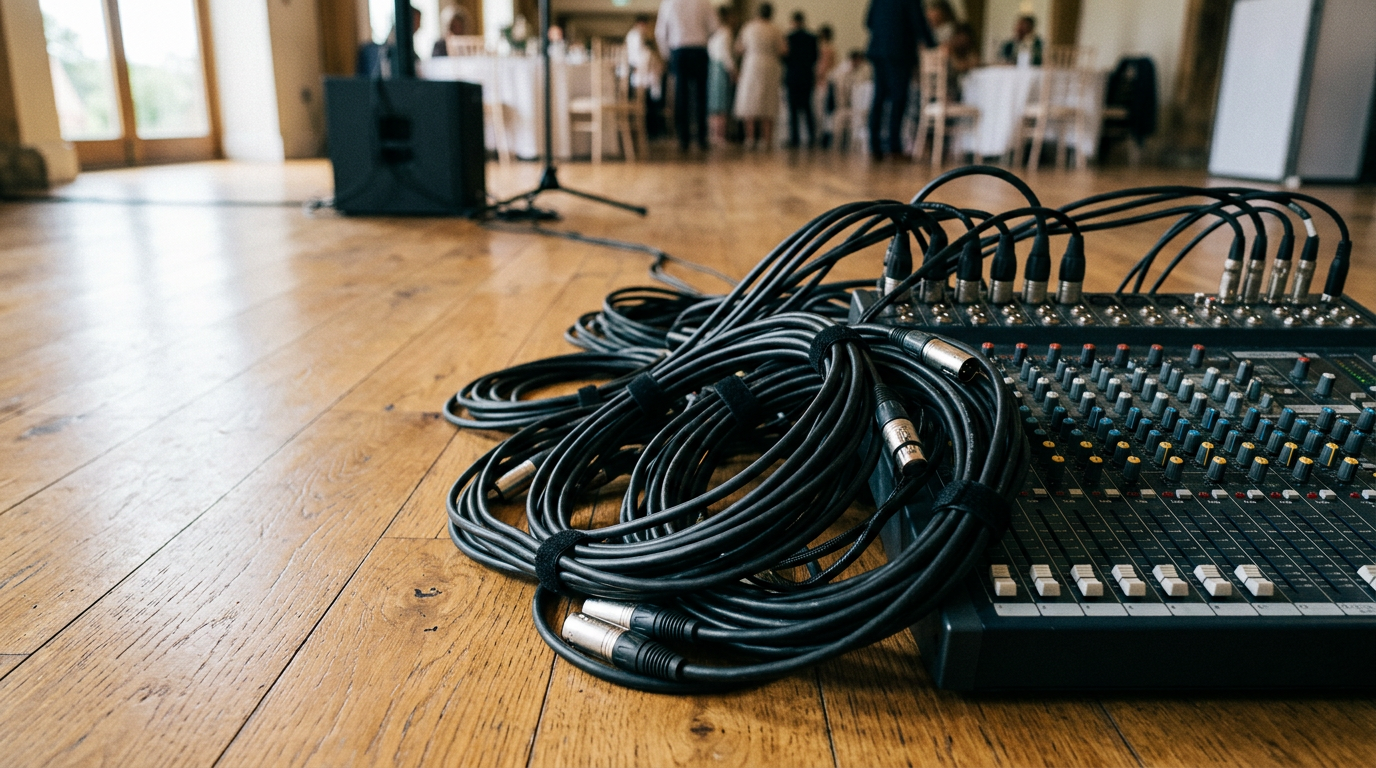
Most couples assume the bulk of their entertainment budget pays for a curated playlist and a microphone. In reality, the music is the cheapest component in the room. Evaluating wedding dj packages requires looking past the tracklist and examining the physical infrastructure that stops an event from collapsing. What you are actually buying is risk mitigation: sequential dependency management, room acoustics control, and a technical framework that guarantees a single tripped circuit breaker does not end the night in silence. When a celebration shifts from a formal dinner to a high-energy reception, the transition relies entirely on an invisible network of cables, wireless frequencies, and contingency plans. Failing to scrutinise those elements before signing a contract leaves the evening exposed to single points of failure.
Quick Summary
Choosing the right technical setup dictates whether your reception runs seamlessly or halts abruptly. Professional DJ contracts categorise their offerings into specific operational models, balancing equipment footprint against acoustic control and runtime. Knowing which framework matches your venue prevents costly mismatches on the day.
- Venue constraints dictate your audio footprint; historic buildings often feature strict sound limiters.
- Redundancy costs money, but hot-swappable backup equipment rescues failing timelines.
- Metered packages separate the afternoon from the evening, requiring strict schedule management.
- Site-planned services incorporate architectural lighting and spatial design before the equipment ever leaves the van.
Table of Contents
- Understanding Service Delivery Models Before Booking
- 1. Motion Entertainment
- Urban venues dictate the equipment footprint
- 2. Select Mobile Disco Hire
- Redundancy is a line item you must pay for
- 3. Big Chief Audio Events
- Modular pricing separates the afternoon from the evening
- 4. AURA Wedding DJs
- Spatial planning dictates the final aesthetic
- Aligning Your Venue With the Right Technical Framework
- Recommended Reads
| Product | Service Delivery Model | Features | Pros | Cons | Target Audience |
|---|---|---|---|---|---|
| Motion Entertainment | Venue-Constrained Specialists | Full lighting, wireless mic, unlimited requests | Pre-agreed access timings, £350 reception baseline, compact booth design | Multi-room setups fall outside scope, single-system limitation, crowd-led music focus | Couples navigating strict council noise limits or tight venue access |
| Select Mobile Disco Hire | High-Reliability Packages | Backup equipment, DJ contingency plan, planning meeting | Hot-swappable audio gear, on-call secondary operators, dedicated music consultation | Rigid 5-hour boundary, premium baseline fee, requires strict schedule adherence | Planners demanding documented fallbacks for single-point timelines |
| Big Chief Audio Events | Time-Metered Full-Day | Ceremony control, 2 mics, background audio | Granular £80/hr overtime, covers aisle walk to final song, defined capacity caps | Standard tier stops at 150 guests, £100 advance deposit required, fragmented pricing | Hosts managing sprawling events that require modular scheduling |
| AURA Wedding DJs | Consultative Site-Planned | Location visits, video consultation, PAT/PLI certified | Site-specific spatial mapping, architectural lighting focus, pre-event visual checks | Restricted operational footprint, premium £500-£700 bracket, redundant in dry-hire venues | Clients transforming blank-canvas marquees or complex architectural spaces |
Understanding Service Delivery Models Before Booking
Evaluating the technical provision of a mobile disco requires moving past the standard promises of a full dancefloor. To accurately compare options, you must categorise the providers by their Service Delivery Model. This classification axis strips away the marketing language and reveals exactly where a company focuses its operational budget. The models break down into four distinct categories.
Venue-Constrained Specialists engineer their equipment to pass through narrow service lifts and operate under the draconian environmental health sound limiters found in historic city centres. High-Reliability Packages dedicate their margin to owning two of everything, ensuring a blown amplifier never stops the music. Time-Metered Full-Day operators build their contracts around the clock, offering modular blocks of time that scale from the ceremony processional down to the final encore. Finally, Consultative Site-Planned providers operate similarly to architectural lighting designers; they mandate physical site visits to map power loads and sightlines before deciding which speakers to load into the van.
Practical rule: Never assume a venue’s in-house power supply can handle a custom lighting rig without an explicit load calculation; always demand the provider physically inspects the fuse board if they plan to run heavy electrical draws.
When calculating your professional wedding dj cost, the figures quoted rarely reflect the music itself. You are funding £10m Public Liability Insurance policies, regular Portable Appliance Testing (PAT) certifications, and the logistical heavy lifting required to turn an empty room into an acoustic environment. If a provider cannot produce a valid PAT certificate, most Grade I listed buildings will simply refuse them entry at the loading bay.
1. Motion Entertainment
Navigating historic venues usually means dealing with environmental health sound limiters that cut circuit power the moment a bass frequency peaks over a defined decibel threshold for more than five seconds. Motion Entertainment engineers their setups around these exact constraints. Operating across London, Bedfordshire, Hertfordshire, and Buckinghamshire, they focus heavily on pre-agreeing access timings and setup details before the event date.
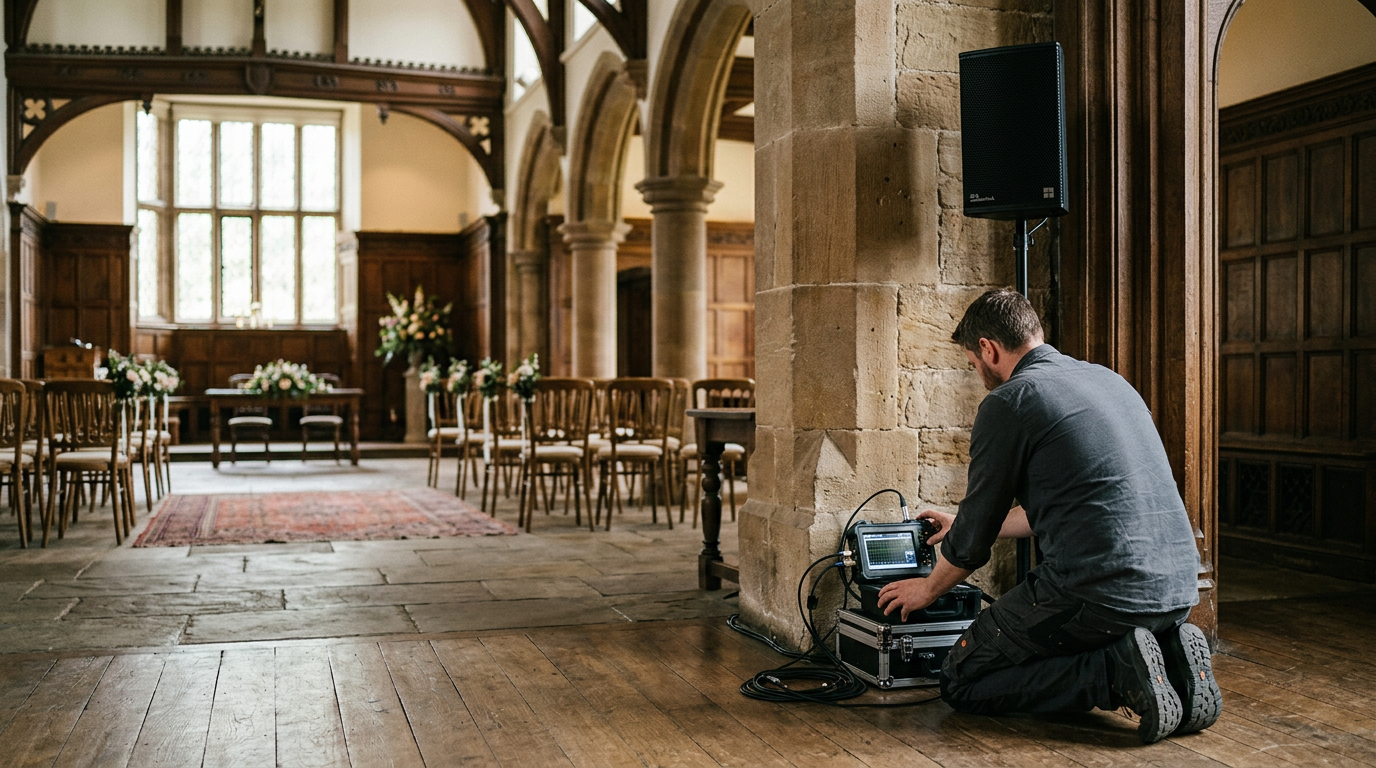
Their mechanism relies on a compact, highly efficient signal chain. By consolidating the DJ booth, sound system, and full lighting display into a single footprint, they avoid sprawling cable runs that create trip hazards in tight loading docks. The standard reception package starts at £350, whilst birthday and anniversary packages drop to a £275 baseline. This includes a wireless microphone and an open policy for unlimited song requests, ensuring the audio remains responsive to the floor.
Urban venues dictate the equipment footprint
Their focus on navigating tight access means the standard £350 package is optimised for single-room, heavily regulated spaces. I would hesitate to deploy this package in a sprawling, multi-room estate where the sound needs to carry across physical boundaries, as a single consolidated system cannot push volume through brick walls without distorting the primary dancefloor.
The baseline rate is highly competitive, but the reliance on unlimited song requests suggests a crowd-led evening; couples demanding absolute control over obscure genre curation may find this open-format approach misaligned with their vision.
Secure this option when the venue enforces rigid loading times or strict acoustic restrictions that standard rigs would trip.
Pros
– Compact equipment footprint fits narrow urban venue access routes.
– Pre-agreed access timings prevent friction with rigid venue coordinators.
– Highly competitive £350 baseline secures comprehensive single-room audio.
Cons
– Open request policy dilutes strict genre curation.
– Single-room optimisation limits acoustic reach in sprawling venues.
– Lower price point removes the buffer for extensive on-site spatial planning.
2. Select Mobile Disco Hire
The moment a primary amplifier fails halfway through a first dance is the exact second a premium invoice justifies itself. Operating out of Cambridge, Select Mobile Disco Hire structures their service around risk mitigation. Their standard fee starts from £595 per night, built specifically around a five-hour performance window.
This provider operates on a High-Reliability Packages framework. The mechanism goes beyond simply owning spare cables. Bookings explicitly include backup equipment and a formal DJ contingency plan, meaning hot-swappable active speakers and on-call secondary operators are factored into the operational cost. Before the equipment is even tested, the process requires a detailed music planning meeting to lock in the acoustic parameters. You are paying for the administrative overhead that guarantees the music does not stop when the hardware inevitably degrades.
Redundancy is a line item you must pay for
If my schedule shifted dynamically throughout the day, I would find this rigid five-hour boundary too constraining. It is a hard limit. The fixed five-hour performance window means an early afternoon reception stretching into the early hours will require bridging that silence through alternative audio sources or renegotiating the baseline contract.
That strict boundary forces discipline upon the event timeline. You must meticulously map the speeches, the cake cutting, and the final dance to ensure they all sit neatly inside the contracted window, leaving no room for a dinner service that runs ninety minutes over schedule.
This package suits receptions entirely reliant on a single timeline where technical failure would derail the evening without recovery.
Pros
– Explicit contingency planning guarantees continuity during hardware failures.
– Detailed planning meetings lock down the acoustic and scheduling parameters.
– Hot-swappable backup equipment prevents dead air during the reception.
Cons
– Rigid five-hour boundary punishes late-running dinner services.
– Premium £595 baseline fee excludes lower-tier budget calculations.
– Strict timeframes require meticulous coordination with the catering team.
3. Big Chief Audio Events
A common miscalculation when budgeting for a reception is ignoring the dead air between the ceremony and the evening meal. Big Chief Audio Events separates the afternoon from the evening through metered runtime. Based in Worthing, they operate firmly within the Time-Metered Full-Day category, allowing clients to bolt on specific operational hours as the event expands.
Their mechanism isolates distinct phases of the day. Decisions usually revolve around the £400 standard four-hour reception package, the £780 full-day option, and the £80 hourly rate for cleanly metered extra playing time. The full-day package shifts the technical load, covering ceremony music control, supplying two wireless microphones exclusively for speeches, handling the background ambient audio, and managing the evening setup. Booking requires an advance deposit, which they deduct directly from the final balance.
Practical rule: Never rely on a venue’s in-house Wi-Fi to stream processional music; professional audio delivery requires locally downloaded tracks and a dedicated, battery-powered PA system at the end of the aisle.
Modular pricing separates the afternoon from the evening
I would mandate the full-day upgrade immediately if the ceremony and reception occupy the same venue, as managing two distinct acoustic zones requires dedicated hardware. The standard package explicitly caps coverage at 150 guests. That is a structural boundary. Attempting to force this baseline rig into a grand hall or a sprawling estate will result in underpowered audio at the back of the room and clipping distortion near the dancefloor.
Their modular approach means you only pay for the hours you consume, but it also places the burden of accurate timekeeping firmly onto the client. Misjudge the length of the speeches, and that hourly overtime rate triggers quickly.
Opt for this full-day structure if the celebration demands continuous audio management from the aisle walk straight through to the final song.
Pros
– Clean £80 hourly overtime rate provides financial predictability.
– Full-day tier includes dedicated wireless microphones for the top table.
– Segmented pricing allows precise control over the entertainment budget.
Cons
– Standard tier strictly limits audio coverage to 150 guests.
– Fragmented timeline management requires active monitoring on the day.
– The £100 advance deposit creates an immediate upfront capital requirement.
4. AURA Wedding DJs
Standing in a bare marquee attempting to visualise where an intelligent lighting rig should sit requires more than an email exchange. AURA Wedding DJs function as spatial planners as much as audio technicians. Operating across Buckinghamshire, Hertfordshire, Oxfordshire, and Bedfordshire, they run a Consultative Site-Planned model that treats the room architecture as a primary variable.
Before any equipment is assigned, their mechanism mandates a video consultation followed by a physical location visit. This allows them to map power socket loads, determine where uplighting will wash best against the venue walls, and ensure the booth does not block fire exits. Their Oxfordshire packages range from £500 to £700. Every piece of equipment deployed is PAT-certified, and the operation is shielded by full public liability insurance, ensuring compliance with the strictest regional estate managers.
Spatial planning dictates the final aesthetic
I would hold off on this tier if the venue already provides an integrated sound system, as the site-planning premium becomes redundant when the acoustic layout is pre-determined. Their operational footprint is heavily tied to the Home Counties. Because they regularly perform at venues across Milton Keynes, Buckingham, Oxford, Bicester, Bedford, St Albans, and Northampton, the mandatory location visit restricts their reach. Couples hosting celebrations in the far north of the UK are structurally excluded from this specific service.
The requirement to physically inspect the venue adds undeniable security to the setup process, but it also demands more of your own time during the planning phase. You cannot simply pay an invoice and forget about it; you must walk the site with the technician.
Reserve this service for blank-canvas locations that require dedicated spatial planning and integrated visual design.
Pros
– Mandatory location visits prevent logistical surprises on the morning of the event.
– Spatial mapping ensures lighting rigs complement the room’s architecture.
– Strict adherence to PAT and PLI standards clears administrative hurdles instantly.
Cons
– Regional constraints exclude celebrations located outside the Home Counties.
– Premium £500-£700 bracket stretches baseline entertainment budgets.
– Heavy consultation requirements demand significant client time investment.
Aligning Your Venue With the Right Technical Framework
Securing the right wedding dj hire comes down to matching the provider’s Service Delivery Model directly against the physical constraints of your venue. Choosing a package based purely on the quoted price guarantees friction when the equipment arrives at the loading dock.
If your reception takes place in a heavily regulated urban hotel with strict council noise limits, the Venue-Constrained Specialists are the only logical choice. Their rigs are designed to remain under the decibel threshold, preventing the power from being violently cut mid-song.
When managing an anxious planning process where the entire timeline relies on the audio system functioning perfectly, point your budget towards High-Reliability Packages. The premium pays for the peace of mind that a hot-swappable speaker is sitting in the van.
For sprawling, continuous events that move from the ceremony room to a courtyard drinks reception before settling in a main hall, the Time-Metered Full-Day operators provide the necessary flexibility. They allow you to scale the hardware and the hours as the day expands.
Finally, if you have rented a bare marquee or an empty barn, the Consultative Site-Planned providers are essential. They will map the power limits and the uplighting angles, ensuring the empty space actually feels like a cohesive acoustic environment by the time the guests arrive.
Pingback: 4 Top Wedding Photographer Options and Packages Evaluated for 2026 – JP the DJ