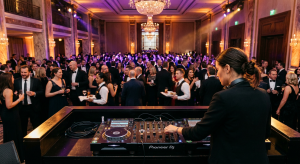
An event coordinator finalises the timeline for a 400-person product launch and realises the venue’s installed sound system is meant for background speeches, not a headline musical act. Finding the right dj for corporate events is rarely just about picking a playlist. It requires navigating equipment logistics, negotiating travel minimums, and establishing liability cover before a single track is played. A corporate buyer must decide whether to pay an agency premium to handle the technical compliance and backup planning, or use a matching platform to stretch the entertainment budget further while taking on the vendor vetting themselves.
Quick Summary
Booking corporate entertainment requires choosing between full-service agencies that manage equipment and liability, and zero-commission platforms that merely introduce you to the talent. The right choice depends entirely on your internal technical capability and risk tolerance.
- Full-service agencies bundle performance, equipment, and backup planning into a single contract.
- Direct-hire platforms remove commission fees but leave vendor vetting and AV provision to the buyer.
- Travel fees and prime-time minimums drastically alter the baseline cost of regional acts.
- Assessing a provider’s approach to dry hire versus wet hire dictates your remaining production budget.
Table of Contents
- How to evaluate corporate entertainment agencies
- 1. Storm DJs
- Custom quoting requires an exact event brief upfront
- 2. SpinSisters
- Premium rates apply to non-local and prime-time slots
- 3. DJ Agency
- Zero-commission matching leaves vetting entirely to the buyer
- 4. Jonny Ross Music
- Transparent travel fees favour regional event planning
- Buying Guide / How to Choose
- Which provider fits your corporate bottleneck
- Recommended Reads
How to evaluate corporate entertainment agencies
The commercial music booking sector operates on a spectrum between full liability assumption and pure disintermediation. When assessing these options, you are not comparing track lists. You are comparing contractual structures.
A full-service agency acts as a shield between the corporate buyer and the individual performer. If the performer falls ill, the agency is contractually obliged to source a replacement. If a speaker blows during the soundcheck, the agency’s production partner swaps it out. Conversely, booking platforms operate as digital introduction services. They strip out the agency markup, returning that budget to the buyer, but they also strip out the safety net. Evaluating these providers means deciding whether your event team has the capacity to act as a technical production manager, or if you need to buy that capacity from the vendor.
| Provider | Features | Pros | Cons | Target Audience |
|---|---|---|---|---|
| Storm DJs | Bundled packages (DJ, AV, booth), integrated insurance, backup rosters | Eliminates technical AV planning for the buyer; guarantees performer replacement | No transparent baseline pricing; requires comprehensive brief before quoting | Corporate buyers lacking an internal production team |
| SpinSisters | Female DJ collective, London & UK coverage, 20-minute free consultation | Highly specific demographic focus; hourly rate transparency | Equipment is excluded from the hourly rate; steep Saturday minimums | Brand events with existing high-end venue AV infrastructure |
| DJ Agency | Zero commission platform, global reach, direct rate negotiation | Avoids agency markups; broad genre coverage for niche product launches | Platform holds no contracting risk or liability; zero backup provision | Experienced event managers who can audit vendor compliance |
| Jonny Ross Music | Live bands and DJs, regular UK showcase evenings, public TrustScore | Allows buyers to audition acts live before committing a corporate budget | 60p per mile travel fee outside West Yorkshire heavily impacts distant bookings | Northern UK planners with flexible travel budgets |
1. Storm DJs
Storm DJs operates as a comprehensive booking agency providing event music planning and artist booking across the United Kingdom. For corporate planners, their core mechanism is the bundled package. Rather than selling a performer’s time in isolation, their private party and wedding DJ packages can include the DJ, performance time, the necessary sound system, lighting rigs, the physical DJ booth, planning support, and the required insurance coverage.
This is known in the industry as a “wet hire” – the vendor provides both the equipment and the skilled operator. For a corporate event coordinator, this mechanism transfers the technical risk entirely to the agency. The buyer does not need to calculate whether a 2000-watt PA system is sufficient for a 300-person hotel ballroom, nor do they need to coordinate a separate lighting contractor to illuminate the dancefloor. Furthermore, their bookings include backup planning in case a DJ becomes unavailable. In corporate procurement, an empty stage constitutes a catastrophic failure. A standalone DJ cannot easily replace themselves if they fall ill on the morning of a conference; an agency with a deep roster can deploy a replacement without the client ever having to source one.
Custom quoting requires an exact event brief upfront
The commercial limit of this full-service approach is the opacity of the initial discovery phase. You cannot browse a fixed rate card or benchmark their services against a tight budget in the early stages of event planning.
Storm DJs requires clients to share the date, venue, timings, audience, and a music brief to receive a custom quote. If your corporate event is still in the feasibility stage – where you are deciding between spending the entertainment budget on a headline DJ or distributing it across additional event services – this requirement creates friction. You must have your logistical parameters firmly locked in before the agency will reveal the commercial terms. Planners looking for rapid, indicative pricing to get a purchase order approved by finance will find this barrier frustrating, as it forces a detailed consultation before establishing basic budget alignment.
2. SpinSisters
SpinSisters is a booking agency representing a collective of female DJs, servicing corporate events and weddings across London and the wider UK. Their model focuses heavily on providing a specific, premium demographic of performers, which is highly sought after for fashion brand activations, product launches, and modern corporate galas aiming for a specific aesthetic.
Their commercial structure is built firmly on performance time rather than technical provision. According to their published rates, hourly rate DJ fees start at £150 an hour and go up to £600 an hour, explicitly excluding the cost of equipment. They operate a high-touch onboarding process for this performance tier, offering a free 20-minute consultation chat to discuss event needs before contracting. This allows buyers to ensure the performer’s musical knowledge aligns with the brand’s intended atmosphere, which is critical for corporate events where the background music must match the specific demographic of the attendees.
Premium rates apply to non-local and prime-time slots
The honest limit of the SpinSisters offering lies in how quickly those baseline hourly rates escalate due to scheduling and geography, compounded by the lack of included hardware. For prime-time slots like Saturday nights, many DJs on the team have a minimum call-out fee of £500+. Furthermore, if a DJ is not local to the area, the minimum fee usually starts at £200 per hour.
Because these fees exclude equipment, the corporate buyer is purchasing a “dry hire” performance. You are paying up to £600 an hour for the artist to arrive with their music and perhaps a controller, but you must independently hire the PA system, the mixing desk, the foldback monitors, and the lighting rig. If your corporate event is in a dedicated nightclub or a highly specified hotel ballroom with an in-house AV team, this is not an issue. However, if you are planning an event in a dry-hire warehouse or a marquee, the requirement to manage and fund a separate technical production contract on top of steep minimum call-out fees makes this an operationally heavy choice.
3. DJ Agency
DJ Agency functions as a digital booking platform rather than a traditional management agency, matching DJs with venues, clubs, and corporate events across the UK and internationally. Their fundamental mechanism is disintermediation. They connect the corporate buyer with the talent but step out of the commercial transaction entirely.
The platform does not charge platform commission or booking fees, meaning clients only pay the rate agreed directly with the DJ. This is a radical departure from standard agency models that typically bake a 15% to 20% margin into the final invoice. They provide DJs for various event types, specialising heavily in clubs, bars, resorts, product launches, and brand events. Because the platform attracts working club DJs rather than strictly mobile event operators, average rates for corporate event DJs on the platform generally range from £150 to £400 per hour. This gives corporate planners access to highly credible, genre-specific club selectors at rates untouched by corporate markups.
Zero-commission matching leaves vetting entirely to the buyer
The immediate consequence of a zero-commission structure is that the platform holds zero operational responsibility for your event. DJ Agency is an introduction service; they do not manage the contract, they do not hold your deposit, and they do not guarantee the performance.
This limit rules them out for corporate buyers who require a vendor to guarantee compliance. When you book directly through this platform, your internal team must manually verify the performer’s Public Liability Insurance and request their Portable Appliance Testing (PAT) certificates to satisfy the venue’s health and safety officers. More critically, because the platform is not an agency, there is no built-in backup provision. If the DJ misses their flight or falls ill, the platform will not automatically dispatch a replacement. The buyer assumes all the contracting and delivery risk in exchange for bypassing the agency fee.
4. Jonny Ross Music
Jonny Ross Music is a comprehensive music booking agency providing live bands, acoustic acts, and DJs for weddings, private parties, and corporate events. They operate on a high-trust, hybrid model that blends live instrumentation with electronic performance, which is particularly useful for full-day corporate retreats that require background acoustic music during the day and a high-energy DJ set for the evening gala.
Their mechanism relies heavily on visible social proof and physical auditioning. They hold a 5.0 TrustScore out of 5 based on more than 730 reviews on Trustpilot, providing the verified paper trail that corporate procurement departments often demand before releasing deposits. Crucially, they offer regular Music Showcase Evenings across the UK where buyers can experience acts live. For an event committee trying to agree on the right tone for an end-of-year party, the ability to stand in a room and hear the act perform before signing a contract removes the guesswork that usually plagues online entertainment booking.
Transparent travel fees favour regional event planning
The geographic reality of their pricing structure creates a hard limit for planners outside of their primary operating region. The agency charges a travel fee of 60p per mile for bookings outside of West Yorkshire.
While transparent, this fee compounds aggressively. If you are organising a corporate event in Aberdeen, London, or Cornwall, the round-trip mileage will add hundreds of pounds to the final invoice before a single piece of equipment is unloaded. For a 400-mile round trip, that is a £240 surcharge strictly for transport. Buyers in Scotland or the south of England must decide whether the assurance of a highly reviewed agency is worth absorbing a travel premium that could otherwise be spent on longer performance hours or enhanced venue lighting from a more local supplier.
Buying Guide / How to Choose
Selecting the right provider requires matching your internal event management capabilities with the operational model of the supplier. The performance is only the final ten percent of the transaction; the preceding ninety percent is entirely logistical.
1. Dry Hire vs. Wet Hire
You must establish exactly what the hourly rate or package fee includes. A DJ charging £200 an hour who only brings a laptop (dry hire) requires you to source, rent, and engineer the PA system and lighting separately. A provider quoting a £900 flat fee who brings full sound and lighting (wet hire) is acting as both the performer and the technical production crew. If your venue is a fully equipped nightclub, dry hire saves money. If your venue is a hotel conference room, wet hire is mandatory.
2. Compliance and Venue Access
Corporate venues in the UK operate under strict liability rules. Your provider will be stopped at the loading bay if they cannot produce an up-to-date Public Liability Insurance (PLI) certificate (standard minimums are often £5m or £10m) and valid PAT certificates for every piece of electrical equipment they intend to plug into the venue’s mains. Agencies bundle this compliance checks into their service; platforms leave the auditing to you.
3. Redundancy and Backup
Corporate events do not have the flexibility to cancel a keynote or a gala dinner because a vendor caught the flu. You must scrutinise how the provider handles non-appearance. Agencies with deep rosters maintain on-call backups. Independent artists booked through zero-commission platforms cannot offer this guarantee, leaving your event exposed to single points of failure.
Which provider fits your corporate bottleneck
No single booking model serves every corporate requirement. The correct choice depends on which resource your planning team is shortest on: budget, technical expertise, or time.
- If your bottleneck is internal technical expertise, take Storm DJs. Their wet-hire packages mean you do not have to translate audio specifications or hire separate lighting contractors, and their backup roster protects the event timeline.
- If your bottleneck is finding a highly specific brand aesthetic for a fashion launch or high-end retail activation, take SpinSisters. Their consultation process and specific demographic focus allow for tight alignment with brand guidelines, provided you have the budget for the dry-hire minimums.
- If your bottleneck is budget and you have an in-house AV team, take DJ Agency. You can secure credible club selectors at £150 to £400 per hour without paying an agency premium, so long as you are willing to handle the contracting and compliance checks yourself.
- If your bottleneck is committee approval, take Jonny Ross Music. The ability to send stakeholders to a live showcase evening to vet the act, combined with a 5.0 TrustScore, provides the consensus and procurement safety required to sign off on regional events near West Yorkshire.