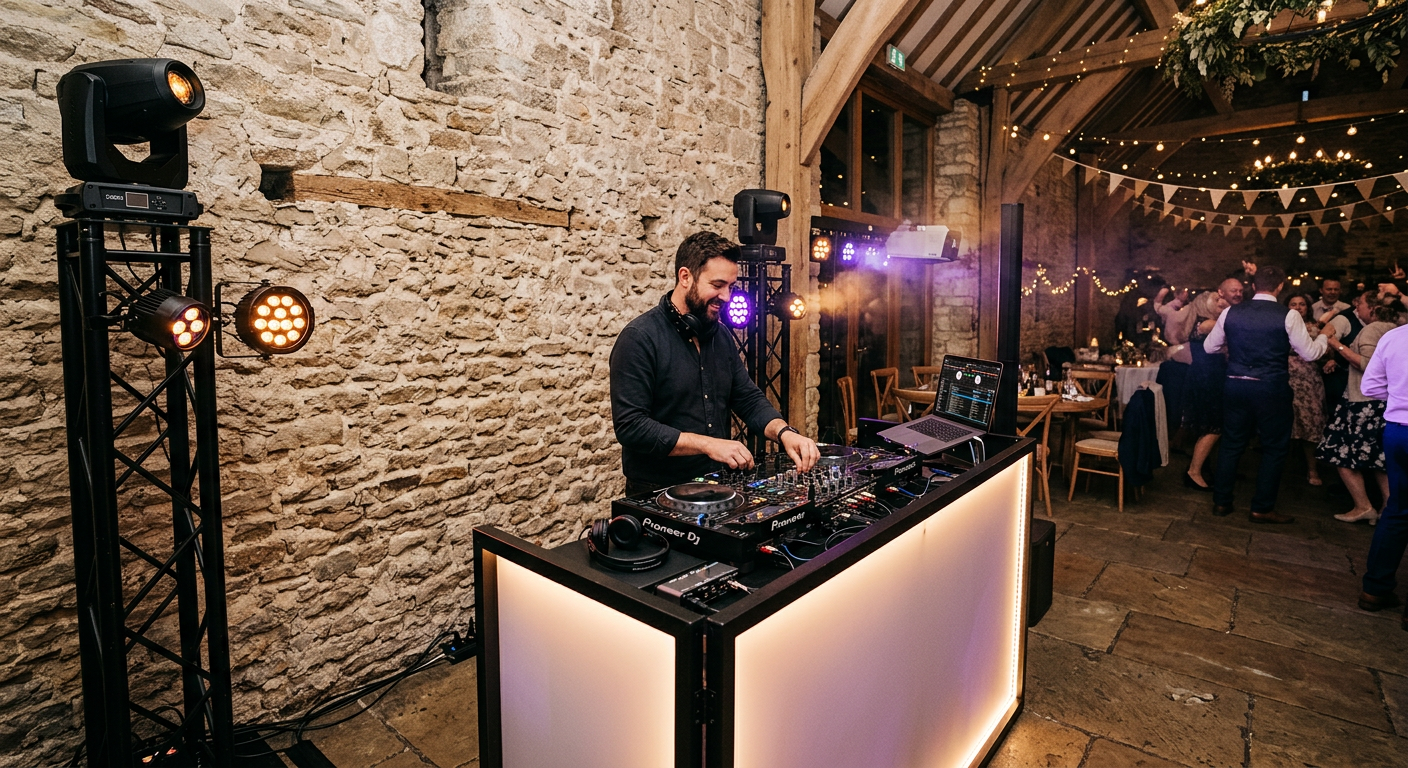
A venue coordinator hands over the final timeline on a Saturday morning, and the biggest variable on the sheet is the entertainment load-in. Finding the exact wedding dj surrey venues trust is rarely about the playlist – it is about power distribution, liability insurance, and load-in logistics. Most couples assume the performance is what they pay for, but the reality is that the bulk of a professional’s fee covers administrative stability and hardware architecture. ‘The DJ was too quiet’ is not an acoustic diagnosis; it is a failure to match the hardware footprint to the room’s dimensions long before the event began.
Quick Summary
Evaluating the regional entertainment market requires separating solo independent operators from structured agencies and decoupling talent fees from hardware rentals. Choosing the right operator depends entirely on whether your priority is fixed pricing, roster redundancy, or hyper-local venue familiarity.
- Fixed-package models lock in costs but restrict bespoke hardware builds.
- Hourly talent pricing mimics commercial dry-hire, allowing precise acoustic scaling at a premium.
- Agency structures provide immediate emergency cover but remove your control over the exact performer.
- Solo specialists offer direct accountability but carry single-point-of-failure risks.
Table of Contents
- Evaluation Criteria
- Comparison Table
- 1. Fizz and Groove
- Fixed packaging secures evening costs early
- 2. SpinSisters
- Decoupling hardware from talent fees changes the baseline
- 3. RedLine DJs
- Roster depth mitigates single point of failure risks
- 4. DJ Ashley Riggs
- Direct booking guarantees the performer on the contract
- 5. Sundown Sounds
- Wider operational radii suit cross county logistical planning
- Buying Guide / How to Choose
- Matching the Solution to the Schedule
- Recommended Reads
Evaluation Criteria
Before analysing individual operators, you must establish the structural lens used to separate them. When determining the framework for your evening, you may initially debate the merits of a Wedding DJ vs Wedding Band, but once you commit to a DJ, the focus shifts to operational models. We judge these options on their pricing architecture (flat-fee packages versus hourly commercial billing), their redundancy mechanisms (agency backup versus solo operator vulnerability), and their hardware deployment. The right choice depends entirely on whether your venue demands a massive, custom-built soundstage or a streamlined, low-footprint installation that fits into a historic dining room.
Comparison Table
| Operator | Features | Pros | Cons | Target Audience |
|---|---|---|---|---|
| Fizz and Groove | £1,200 standard packages, £1,500 gold packages, online portal | Locks in production costs early; avoids 20% VAT levy | Restricts bespoke hardware changes; strict booking limits | Budget-conscious couples needing predictable, flat-fee scaling |
| SpinSisters | £150-£600 hourly talent rates, separate £450-£1,400 production | Commercial dry-hire model allows precise room scaling | Unpredictable final invoice if timelines slip | Clients prioritising club-standard talent over fixed pricing |
| RedLine DJs | Managed central roster, multi-county agency deployment | Corporate redundancy absorbs illness or vehicle breakdowns | Distances the client from the actual performer | Event planners demanding guaranteed cover over personality |
| DJ Ashley Riggs | Solo specialist workflow, deep regional venue familiarity | Direct accountability; fast, frictionless local load-ins | Lacks immediate identical backup if disaster strikes | Couples wanting direct rapport with a guaranteed individual |
| Sundown Sounds | Scaled regional deployment, standardised modular hardware | Bridges cross-county logistics for distant clients | Transit vulnerabilities across vast territories | Scalable events requiring broad logistical reach |
1. Fizz and Groove
Fizz and Groove is a professional wedding DJ and mobile disco hire service operating across Surrey and London, designed for couples who want transparent, tiered packages rather than an unpredictable hourly billing system. They operate a strictly fixed-package structure that locks in production variables early. Their Standard DJ Package, priced at £1,200, delivers five hours of music, an inclusive sound and lighting rig, a rustic DJ booth, and an online playlist portal for collaborative music selection. Their Gold Package scales the evening’s physical footprint up to £1,500 by integrating a photo booth, a flower wall, and custom neon signage. Crucially, they actively manage their corporate structure to keep annual sales under £95,000. By deliberately remaining below the standard VAT registration threshold, they prevent the automatic 20% tax levy from hitting the end consumer’s final invoice. In the UK events industry, a 20% VAT addition on a £1,500 package adds £300 purely in taxation, making this structural threshold a tangible financial discount mechanism.
Fixed packaging secures evening costs early
By deliberately capping their annual turnover to avoid VAT registration, they inherently limit the volume of bookings they take per year. Couples who decide to book late in the summer season will almost certainly find their calendar closed. Furthermore, because the hardware is sold as a set package, those seeking highly bespoke, modular stage builds – such as specifying exact wattage requirements for a massive marquee – will find fixed packages too restrictive. You must physically measure their rustic booth against your venue’s allocated dancefloor space to ensure the footprint fits seamlessly.
- Pros: Flat-fee structure eliminates surprise late-night billing; deliberate tax structuring passes a 20% saving directly to the consumer.
- Cons: Artificially capped booking volume limits availability; fixed rigs cannot easily scale to suit extreme venue dimensions.
2. SpinSisters
SpinSisters is an all-female DJ collective providing entertainment services across Surrey, London, Hampshire, and beyond, catering to clients who want premium club-standard talent and are willing to pay for the hardware separately. Unlike standard mobile operators who bundle a generic speaker system with their time, SpinSisters divorces the talent fee from the production hardware. Their DJ hourly rates scale from £150 up to £600 depending on the specific performer’s industry profile, the date, and the venue location. Once the performer is secured on the contract, the physical equipment is treated as a separate, commercial rental line item. Their production packages start at £450 for basic room setups and scale to £1,400 for comprehensive event hardware. This mechanism mimics commercial dry-hire practices, allowing couples to book premium talent while scaling the PA system precisely to the room’s specific acoustic demands and guest count.
Decoupling hardware from talent fees changes the baseline
The open-ended nature of hourly billing creates unpredictable final invoices if a wedding timeline slips or the party extends past midnight. A five-hour booking with mid-tier production easily surpasses £2,000, making this model entirely unsuitable for couples requiring fixed, guaranteed costs before the planning day begins. Because the collective spans multiple counties, the geographical distance between the specific DJ assigned to your contract and the venue itself introduces travel variables. You must confirm directly with them if the hourly rate begins at load-in or exclusively covers live performance time, as a two-hour setup phase heavily alters your baseline cost.
- Pros: Commercial hardware scaling ensures the sound system precisely matches the room; allows access to high-profile performers on an hourly basis.
- Cons: Runaway costs if the event timeline drags; geographic spread means your talent might be travelling long distances to the venue.
3. RedLine DJs
RedLine DJs is a wedding DJ hire agency operating across Surrey, Sussex, London, Kent, and Berkshire, built for event planners and couples who prioritise guaranteed coverage over booking one specific individual. RedLine DJs functions as a central booking hub rather than a sole proprietorship. When you contract an agency, you are purchasing access to a managed roster of vetted performers rather than hiring a single personality. The agency holds the master contract, standardises the equipment deployment across the board, and assigns a DJ from their pool who matches your specific brief. This centralisation means the administrative burden – handling insurance documentation, PAT certificates, and venue liaison – is handled by dedicated back-office staff rather than the performer themselves. If an assigned DJ falls ill on a Friday morning, the agency’s internal network absorbs the shock by dispatching a direct replacement from within the roster, entirely bypassing the need for the couple to emergency-hire a substitute.
Roster depth mitigates single point of failure risks
Booking an agency inherently distances the client from the actual performer. You are buying into a corporate standard rather than a specific personality, meaning you surrender granular control over exactly who arrives on the night. Couples who want to build a deep rapport with their exact DJ over months of planning should skip the agency model entirely, as the final personnel allocation may not be confirmed until just weeks before the event. You must check your master contract to see if you hold any veto rights over the final assignment or if the agency dictates the roster completely.
- Pros: Back-office administrative support removes planning friction; internal roster redundancy virtually eliminates the risk of an empty stage.
- Cons: Prevents direct relationship building with the performer; standardises the performance rather than offering a truly bespoke artistic touch.
4. DJ Ashley Riggs
DJ Ashley Riggs is a professional wedding specialist DJ focusing heavily on the Hampshire and West Sussex regions, ideal for couples seeking direct accountability from the person operating the equipment on the night. As an independent specialist operator, the entire service chain – from the initial sales enquiry to the midnight pack-down – is handled by one individual. This single-operator workflow means the person conducting the site visit or planning consultation is identical to the person wiring the speakers. The operational mechanism here relies on deep, hyper-local venue familiarity. A specialist operating strictly within a defined regional pocket accumulates highly practical knowledge of specific venue sound limiters, loading bay dimensions, and acoustic dead zones. This heavily reduces the friction of the setup phase, as the operator does not need to learn the building’s physical quirks on the day of the wedding, allowing for a much faster, cleaner installation before the evening reception begins.
Direct booking guarantees the performer on the contract
The defining strength of a sole operator is simultaneously their primary structural weakness: a complete lack of immediate, identical redundancy. If a severe illness or vehicle breakdown occurs on the day of the event, an independent DJ must rely on external industry goodwill and informal network contacts to find a replacement, rather than dispatching in-house staff. Couples booking a solo specialist must actively check the contingency clauses in the contract to understand exactly how emergency cover is sourced, vetted, and funded if the worst happens. Furthermore, solo operators lack the capacity to scale their physical footprint beyond what fits in a single transit vehicle.
- Pros: Guarantees the person you plan with is the person who performs; deep venue knowledge reduces load-in friction and acoustic errors.
- Cons: Highly vulnerable to sudden illness or transit breakdowns; hardware scale is strictly limited by single-vehicle logistics.
5. Sundown Sounds
Sundown Sounds is an event and wedding DJ company providing services across Hampshire, Surrey, and extending into other UK regions, designed for scalable events that require broader logistical reach. Operating across a wider territory requires a substantially different logistical framework than a hyper-local independent operator. A company dispatching equipment across multiple UK regions must standardise its hardware to ensure it fits seamlessly into various transit vehicles and venue constraints. This involves deploying modular staging and standardised lighting trees that can be rapidly assembled by any trained operator on their team. By covering both Hampshire and Surrey, they bridge the geographical gap for couples who live in one county but are hosting their reception in another, greatly simplifying the consultation and booking process. The corporate structure handles the complex cross-county logistics, ensuring that transit times, regional venue compliance, and equipment manifests are calculated and verified well before the event date.
Wider operational radii suit cross county logistical planning
Expanding operations across vast territories introduces severe traffic and transit vulnerabilities, particularly on the M25 and A3 corridors during peak summer weekends. Multi-region companies often rely on contracted local cover rather than dedicated in-house staff for venues sitting at the extreme edge of their territory. You must explicitly verify where the physical hardware for your event is warehoused. If the equipment depot is located three hours away from your chosen venue, a blown amplifier discovered during the afternoon soundcheck cannot be easily swapped or repaired before the first dance begins, introducing unacceptable downtime to the evening.
- Pros: Bridges logistical gaps for cross-county planning; modular hardware adapts well to varying venue sizes and constraints.
- Cons: Long transit lines expose the setup to severe traffic delays; hardware depots may be too far away for rapid emergency replacements.
Buying Guide / How to Choose
Evaluating the wedding djs surrey has available requires looking directly past the promotional videos and scrutinising the paperwork. The events industry relies heavily on strict legal compliance, and no reputable venue coordinator will allow a rig to be powered up on their premises without seeing a valid Portable Appliance Testing (PAT) certificate and proof of Public Liability Insurance – typically mandated at £10 million. If an operator cannot produce these documents digitally within ten minutes of your request, they are not operating at a professional tier and your venue will likely reject their load-in entirely.
When evaluating a wedding dj hampshire venues recommend, you must factor the physical footprint of the equipment into your room layout. Adding physical enhancements to the dancefloor changes your power requirements drastically. Supplying items like Confetti Cannons or heavy uplighting rigs means your operator needs longer load-in times and dedicated, isolated power drops to prevent tripping the building’s breakers. You should personally measure the venue’s allocated performance space and demand the exact dimensions of the DJ’s booth. A mismatch here forces the head table to be moved out of position or illegally blocks vital fire exits. Always ask whether their quoted fee covers the setup time, or if the meter starts running the moment the van doors open.
Matching the Solution to the Schedule
If your bottleneck is securing a fixed, unchangeable cost early in the planning phase, take Fizz and Groove’s packaged approach. If you are terrified of a single point of failure and demand corporate-level redundancy, take the agency model offered by RedLine DJs. For those who want club-tier mixing and are willing to pay for talent and hardware as separate line items, SpinSisters provides the necessary commercial structure. If you require seamless cross-county logistics to bridge a venue gap, look to Sundown Sounds. Finally, if you value direct, single-operator accountability and venue familiarity above all else, secure an established independent like DJ Ashley Riggs – provided your timeline allows you to bypass the lengthy waiting lists.